





Sustainable engineering: how we created and shared a brand new open-source carbon measurement engine

With the rise in computer-intensive workloads people are becoming increasingly concerned about the environmental impact of their software. It’s a reasonable concern: data centers around the world now account for 1% of global electricity use and some are concerned that could double by 2030.
At Amadeus, we believe that better travel means caring for the world around us. Our environment, our communities, and our destinations matter. And as the creator of a powerful travel search engine, we know that factoring in sustainability when building our software can have a big impact.
This is the mindset that inspired an ambitious group of Amadeus engineers to build “Carmen” (Carbon Measurement Engine), a brand-new, open-source carbon measurement engine. Because if you’re going to reduce the carbon impact of your applications, the first step is to measure it. So how did they do it? This is their story.
Amadeus’ approach to Green IT
Reducing the carbon emissions in any company as complex and global as ours requires vision, tenacity, and a touch of serendipity. Fortunately for the engineers at Amadeus, they had all three.
Amadeus as a company is committed to being net-zero by 2050 with SBTi-validated targets. As part of that commitment, in 2022, we became the first travel company to join the Green Software Foundation (GSF) to work with the broader industry on global standards alongside the likes of Accenture, GitHub, Microsoft and Thoughtworks.The GSF builds open-source standards and tools like the Software Carbon Intensity specification and Impact Framework that enable organizations to measure and understand their software emissions - critical capabilities as the ICT sector works to meet global climate commitments.
In 2022, Amadeus launched a Green IT center of excellence to create a sustainable engineering culture with awareness and training to standardize best practices, and of course, to build tools to measure and ultimately to minimize emissions across our applications portfolio.
Building Carmen, our carbon measurement engine
Since 2019, Amadeus has monitored the environmental impact of its data center through the Environmental Management System. It helped us identify concrete opportunities for energy efficiency and the possibility to reduce emissions across our physical infrastructure. The next step was clear: bring the same discipline to our applications.
The Green Software Foundation’s Impact Framework (IF) is an industry-recognized tool for measuring software emissions. But implementing it at the scale of Amadeus—with hundreds of applications, each with different owners, architectures, and workloads—was a very real challenge. Asking every team to apply the framework independently would be inefficient, inconsistent, and costly.
We needed a scalable alternative: something reliable, repeatable, cost-effective, and easy for engineers to adopt.
A global team of engineers and apprentices took on this challenge. As we started our migration to the public cloud, together, they began building a minimum viable product that could support Amadeus applications running on Microsoft Azure. Their objective was two-fold: to implement the Impact Framework at scale, and to give teams insights, not just measurements.
The team started by bringing together different open-source solutions that were already available to build a new custom carbon emissions measurement engine that met our requirements. By late 2023, the first dashboards were live. They provided application owners with visibility into the consumption patterns that drive envi-ronmental impact—CPU, then memory and network usage—and highlighted where improvements could minimize both emissions and costs.
The MVP worked. Now it was time to evolve it into something bigger.
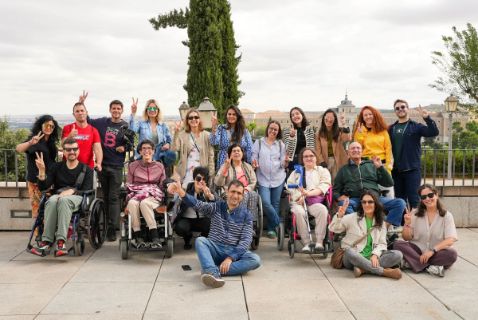
Here, I’d like to thank the whole team that has worked on developing Carmen, especially its creator, Florent Morel, and the product owner, Robin Castellon:

From left to right: Florent Morel, Creator of Carmen at Amadeus; Robin Castellon, Principal Quality Engineer, Product Owner of Carmen, Amadeus; Virginie Corraze, Associate Director, Engineering Centers of Ex-cellence & Dev Relations, Amadeus; Gosia Fricze Gosla, Community Manager, GSF; Russ Trow, Operations Director, GSF.
What our carbon measurement engine does
The engine is built using and extending GSF open-source projects, including the Carbon Aware SDK and the Impact Framework. It provides a practical, scalable way to measure application emissions across diverse workloads, with capabilities that continue to grow.
By coupling environmental insight with operational metrics, the engine helps teams make informed decisions about technical debt, performance optimization, and sus-tainability. It also provides a common data model that brings cloud spend and carbon impact together—two sides of the same efficiency coin.
Why we’re open-sourcing it
Very quickly, it became clear that the challenges we face are not unique. Across industries, companies are struggling to quantify the carbon emissions impact of their software. As cloud usage and computing workloads grow, that demand will only intensify.
Open-sourcing Carmen, our carbon measurement engine, is our way of contributing back to the community and accelerating the development of practical, standardized tools for green software that are provided free of charge. We’re excited to see how it can evolve to address other companies’ needs and support more use cases thanks to contributions from the wider tech community. As more organizations adopt and contribute to it, the engine is expected to become more accurate, more robust, and more useful.
For developers and technical leaders, this engine offers a practical, accessible entry point into sustainable software. It removes barriers to measurement, encourages shared best practices across cloud teams, and supports the standards and reporting that regulators and customers increasingly expect.
Building more sustainable software is a critical part of sustainable technology. By open-sourcing the Carbon Measurement Engine and transfering ownership to the Green Software Foundation, we’re contributing to a more transparent, collaborative, and sustainable digital ecosystem.
The journey to more sustainable systems requires collective action. This engine is one way we’re helping move the industry forward.
Supporting the wider industry
You don’t have to be working in tech to recognize that we’re living through a transformational time. But being a tech innovator is not just about applying the latest technology, it’s about scaling emerging technologies, exploring efficient processes for all stakeholders, and developing more sustainable, long-term solutions that benefit everyone. None of that can be done alone.
As part of our collaboration with the GSF, we are now exploring how to measure the software carbon intensity of AI capabilities in our applications running on our Big Data Platform.
Carmen was inspired by a variety of open-source solutions that already existed, and our carbon measurement engine will continue to evolve as more companies use it. We look forward to seeing how it will benefit the wider industry now that it’s open sourced.




TO TOP