-
Solutions
-
Airlines
-
Airports
-
Border Authorities
-
Corporate Travel & Expense
-
Integrations
-
Travel Sellers
-
-
Payments & e-invoicing
-
 AI at Amadeus
Driving integration, scalability, trust and integrity across the travel industry.
Learn more -
-
-
Support & Training
-
 Already a customer?
Log into My Amadeus Services for product news, learning materials, and customer support.
Login
-
-
-
 Transforming travel with AI
Our partnership with Microsoft accelerates our Cloud journey and unlocks new, AI‑powered innovations that strengthen and elevate the travel industry.
Learn more -
 Landmark partnership between Amadeus and Google Cloud
Learn how this collaboration strengthens Amadeus' multi-cloud approach and AI innovation to improve efficiency, reliability and growth in travel.
Learn more
-
-
-
Trending Topics
-
 Six travel trends that will redefine how we travel in 2026 and beyond
Amadeus, in collaboration with Globetrender, unveils the tech, policy and innovation coming to transform the face of travel.
Discover now -
 Airlines in the agentic age: use cases and ideas for getting started with AI
Built on airline input, with Microsoft support, exploring real AI use cases.
Access whitepaper
-
-
Company
-
About Amadeus
-
Careers
-
Innovation
-
Sustainability
Learn how we’re working to make travel a force for good.
-
 Amadeus Global Report
Gain insights into Amadeus' 2025 business, financial performance, and sustainability.
Read the report -

-
-
- Home
- News
- Press releases
- Manchester Airport redefines terminal design by enabling mixed domestic and international operations with Amadeus biometrics


Pioneering approach removes traditional barriers between domestic and international journeys
Live results show 99% success rate of automated biometric reconciliation process
Manchester Airport has introduced a new operational model for its Terminal 2 that allows domestic and international passengers to seamlessly share the same arrival and departure infrastructure. Enabled by advanced biometric identity reconciliation delivered in collaboration with Amadeus, the airport is addressing the industry-wide challenge of rising passenger volumes and constrained terminal capacity.
Traditional terminal designs that physically segregate domestic and international flows are becoming structurally inefficient, duplicating infrastructure, reducing asset utilization, and limiting an airport’s ability to scale. Manchester Airport’s new model replaces this static segregation with digital orchestration.
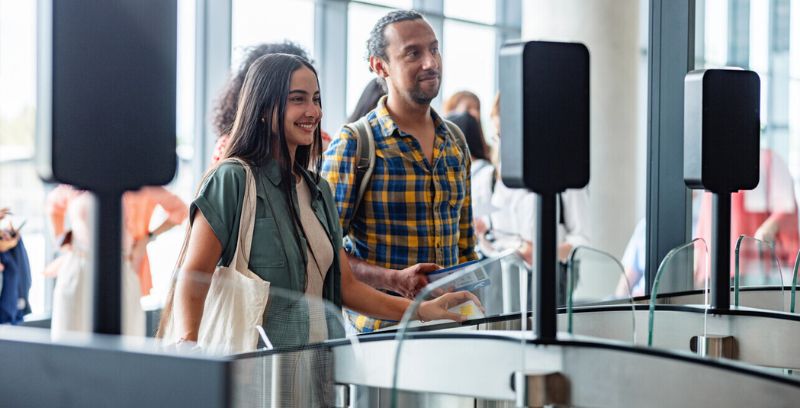
Biometric identity reconciliation embedded into the core passenger journey, enables the airport to confirm a passenger’s eligibility to move through specific zones of the terminal without repeatedly stopping the journey for manual checks. Domestic passengers travelling within the UK’s Common Travel Area can move fluidly through the terminal, while international passengers are seamlessly directed to standard UK immigration processes, including eGates or officer-assisted control operated by the UK Border Force.
This way, Manchester Airport can dynamically manage passengers with different regulatory profiles within shared terminal spaces, while maintaining full compliance
with UK border and aviation requirements.
"Here at Manchester Airport, we’re proud to connect the North to the world – and thanks to our £1.3 bn investment in our infrastructure, we’re doing that through world‑leading facilities. This is a great example of how that investment isn’t just skin deep and shows the way in which innovation is improving passengers’ journeys in ways they may not even notice.
By using biometrics to reconcile passenger identity across different journey types, we can use our space far more intelligently, reduce operational complexity, and deliver a consistently high‑quality experience for all passengers, while still protecting the integrity of border force operations. With Amadeus, we have been able to deliver this model without compromise, balancing passenger experience, asset efficiency, and the strict regulatory requirements of a UK international border."
Chris Woodroofe Managing Director, Manchester Airport
Since going live, Terminal 2’s biometric platform is now processing tens of thousands of passengers each month, with automated reconciliation rates consistently close to 99% across both inbound and outbound journeys, demonstrating reliable mixed-mode operations in a live UK border environment. Operational data also confirms operational and economic benefits, including increased capacity, improved commercial performance, and stronger returns on Manchester Airport’s £1.3billion transformation program.
"Biometrics are not simply about speeding up identity checks.They are becoming the foundation for a new generation of airport operations, where digital identity allows physical space to be used far more intelligently. Manchester Airport shows what is possible when identity management, infrastructure, and regulation are designed together."
Rudy Daniello Executive Vice President, AirOps, Amadeus
Terminal 2’s biometric-enabled operating model is now live for passengers flying with airlines including Aer Lingus, Aurigny, British Airways, easyJet, and Loganair, supporting both arriving and departing journeys.
As Manchester Airport completes the final phase of its Terminal 2 program, the project stands as a clear reference for how airports can modernize passenger processing, increase resilience, and prepare for long-term growth without compromising security or passenger experience.
TO TOP