





The Intelligent Journey 2032 ㅤ
How will AI reshape travel by 2032?
Artificial intelligence could transform travel by 2032. But from the perspective of travelers and the industry, the most profound changes may not be about the technology itself.
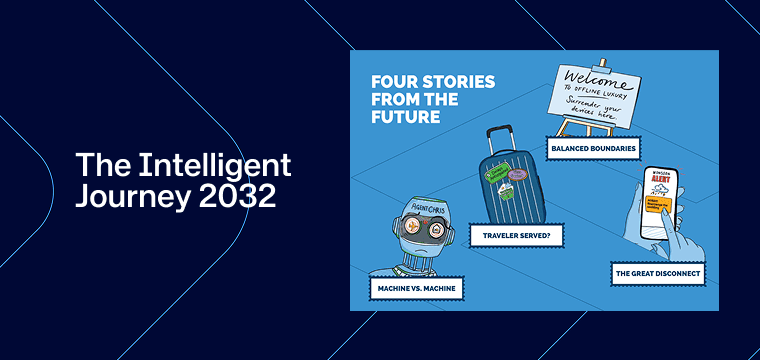
The Intelligent Journey 2032 explores this question through four contrasting but equally plausible future scenarios. Written by scenario planning specialists Stratforma and commissioned by Amadeus, the report is designed not to predict the future, but to help the industry explore uncertainty and consider the choices being made today.
What could happen when increasingly capable AI meets an industry built around complex, interconnected services?
What happens when travelers can choose not only what they want AI to help with, but how much authority they are prepared to give it?
2032
Horizon year
50+
Expert perspectives
2
Critical uncertainties
5
Driving forces
4
Possible futures
6
Cross-cutting tensions
4
Urgent questions
5
Wild cards
Two critical uncertainties.
Four possible futures.
Scenarios, not predictions.
There is no single predetermined future for travel. The scenarios are not predictions, policy positions, commercial claims or descriptions of current Amadeus or industry behavior. They are tools for exploring uncertainty, challenging assumptions and considering how decisions made today could shape what comes next.
Powerful personal AI meets a fragmented travel ecosystem.
Travelers embrace increasingly capable personal AI agents. But fragmented industry systems struggle to deliver on their expectations, particularly when journeys become complex or things go wrong.
AI handles the complexity. Travelers rediscover the human experience.
But as technology becomes more capable, travelers don't necessarily want every aspect of their experience optimized. Choice, spontaneity, authenticity and human connection take on renewed importance.
When AI agents negotiate with AI agents.
Sophisticated consumer and supplier agents compete. But as more decisions happen between machines, transparency over how those decisions are reached, and whose interests they ultimately serve, becomes increasingly important.
Effortless travel but on whose terms?
The travel industry navigates a bold AI transition but consumer adoption is uneven and hesitant. The industry’s challenge is to earn acceptance by demonstrating clear value.
Are any of these the future of travel?
Maybe.
Elements of all four could emerge. Different futures may develop in different markets, for different journeys and at different speeds. The value of the scenarios lies not in deciding which one will be “right”, but in considering what each reveals about the choices, capabilities and relationships that could matter most.
Postcards from the future
Meet four travelers experiencing travel in 2032
Six shared tensions
Look across the four scenarios and common tensions begin to emerge.
These six tensions highlight some of the choices the travel industry may need to navigate as AI becomes more deeply embedded in the journey.
From booking to orchestration
Convenience vs. Control.
Confidence when things go wrong
Intelligence depends on foundations
Borders shape AI's reach
Travel must earn its place

Be prepared for an uncertain future
The Intelligent Journey 2032 brings together possible futures, cross‑cutting tensions and urgent questions to help the industry challenge assumptions and think differently about the choices ahead.
Who will own the relationship with the traveler?
Who takes responsibility for the journey?
How much will travelers delegate to AI?
What are the economics of an AI-enabled travel ecosystem?
Frequently asked questions
The Intelligent Journey 2032 is a report written by scenario planning specialists Stratforma and commissioned by Amadeus. Through four contrasting scenarios, it examines how AI could reshape traveler experiences, industry dynamics and the future of travel by 2032.
The report was written by Stratforma, one of the world's leading authorities on scenario planning, and commissioned by Amadeus. It combines research, expert interviews and scenario planning to explore the critical uncertainties that could shape travel towards 2032.
Travel scenarios are structured explorations of possible futures. Rather than predicting what will happen, they help organizations examine uncertainty, challenge assumptions and make better strategic decisions about what to do today.
Traveler confidence is fundamental to the future of AI in travel. As AI becomes more integrated into planning, booking and servicing journeys, responsible innovation, privacy, transparency and accountability can help ensure technology delivers value for travelers and the wider travel ecosystem. Amadeus is dedicated to the responsible, ethical and secure development, deployment and use of artificial intelligence in travel.