








AI agents can rebook flights through voice conversation.
Operational processes like turnaround management stand out as early areas of innovation and adoption.
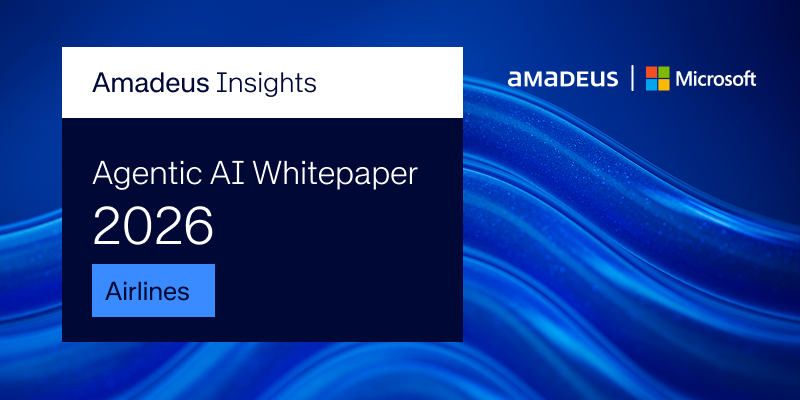
Agentic AI is changing how airlines operate, poised to radically transform many functions, from e-commerce to operations and distribution. That’s according to a major new report from Amadeus, supported by Microsoft, outlining a range of different agentic AI use cases and tangible recommendations, identified through interviews with airlines including Azul Linhas Aéreas, Icelandair, and Southwest Airlines.
Airlines are reaching an inflection point. Agentic technologies are now mature enough to be deployed against predictable, high‑impact workflows — especially in operations, customer service and e-commerce.
The report identifies 5 key use cases where airlines can already generate value through agentic AI:
1) Automated voice rebooking
Trials show an airline AI agent can identify booking, understand verbal change request, propose new options, articulate the fare differential and initiate payment. The AI agent can handle multiple calls in the traveler’s preferred language, aiming to slash call waiting times. Amadeus has successfully tested this technology and it is now ready to move into production.
2) Agentic commerce
The report cites AI’s ability to plan, book and service customized trips, identifying opportunities across airline touchpoints like website, mobile or call center, and setting out options for how airlines can engage with AI assistants like Microsoft Copilot and ChatGPT.
3) Intelligent digital marketing
Another AI agent enables more agile marketing by identifying underperforming routes, recommending a campaign strategy, generating digital ads and allocating spend across channels, before executing and reporting on results.
4) Turnaround management
Teams of AI agents can support aircraft turnaround by monitoring maintenance, crew, re-fueling and other processes to recommend an integrated plan. Icelandair and Southwest Airlines are exploring AI-enabled decision support to improve operational planning.
5) Personalized offers and customer experience
AI agents are replacing static rules and overcoming data fragmentation so airlines can package customized offers and tailored digital experiences. AI enables airlines to orchestrate each traveler’s journey, aligning individual needs with the airline’s strategic priorities.
“We expect agentic AI to improve almost every airline workflow, from network planning to customer service. And for Amadeus, I see great opportunities for AI to reinforce our applications and introduce new capabilities.
As a trusted system‑of‑record in travel, we facilitate travel industry connectivity and orchestration at scale, and this new technology will help us accelerate progress toward a smoother, more connected journey”.
Cyril Tetaz EVP Airline Solutions, Amadeus
The report sets out five key recommendations for airlines adopting agentic AI, starting with the need to build strong data foundations. The results achieved from AI depend heavily on the quality, availability and structure of airline data, making data preparation a critical first step. From there, airlines are encouraged to focus on the workflows where AI can deliver the greatest impact — whether in cost reduction or revenue generation — and to take a targeted, scalable approach.
The report also highlights the importance of identifying the use cases that will deliver measurable value, questioning whether AI is indeed the right tool to use in each case. Where AI is the right tool, strong governance is key to ensuring it scales responsibly, builds trust, and delivers true value to both airlines and travelers.
“2026 will be a defining year for agentic AI in aviation. Over the next 18 months, most airlines will move from exploration to real‑world deployment – embedding agents across the traveler journey and core operations”.
Julie Shainock Global MD for Travel, Transport & Logistic, Microsoft
Published in June 2026, the report, Airlines in the agentic age: use cases and ideas for getting started with AI, provides airline leaders with a practical framework to understand how agentic AI is delivering value today, where risks remain, and what foundations are required to scale responsibly.
Drawing on in‑depth interviews with airline professionals, Amadeus experts and Microsoft industry leaders, the report sets out clear strategic guidance for airlines looking to get started with agentic AI. It also underlines why the next 12–18 months will be decisive for airlines to translate AI ambition into durable operational advantage.

TO TOP