







Why the best AI chatbots in travel don’t always need more chat


In this article...
- Why more conversation isn’t always the answer with chatbots, especially when travelers need to compare options and make confident choices.
- What our research revealed about when travelers prefer familiar, interactive interfaces
- How generated UI can help reduce effort and support complex travel decisions
- Why the future of travel AI needs decisional UX, not just better chat
The question we needed to answer
In my role as UX lead for Amadeus Max for Travelers, an agentic commerce solution offering conversational support to travelers at every stage of their journey, I had to answer a recurring question from product managers and engineers: What should a premium, agent-enabled chatbot experience actually look like?
Much of the industry has settled on a comfortable assumption: agentic commerce means replacing interfaces with conversation.
Our research points in a slightly different direction
As UX practitioners, we value findings supported by multiple converging signals rather than a single piece of evidence. Agentic experiences are still largely uncharted, so we needed a basis for our design decisions.
One of our first questions was simple: When travelers use an agentic chatbot, what kind of experience will meet their expectations?
More specifically, would they prefer raw text, formatted markdown with elements such as headings and emojis, or contextual UI components generated for the task at hand?
Our knowledge of product psychology gave us an initial hypothesis: for many tasks, using a familiar interface requires less effort than writing prompts and reading answers.
There were two main reasons:
- People can scan an optimized UI component more easily than a long, sometimes unformatted text.
- Writing a prompt takes time and effort, while selecting an option in a familiar interface is quick and direct.
That was our hypothesis. Let’s see what the research data showed.
Our first internal studies
In February 2026, we ran a quick survey with a small group of American travelers (N=30). Only 13% selected: “I prefer a chatbot over a regular website.”
One participant explained the concern clearly:
“I would get mad if the AI chatbot made obvious mistakes. Like booking the wrong times. Or wrong seats. I'd probably get mad if they were too pushy. Like a salesman.”
Why did so many favor a familiar interface? Our interpretation was that participants associated chatbots with tools that required more work while producing answers they could not fully trust.
This small sample was not enough to guide product decisions on its own.
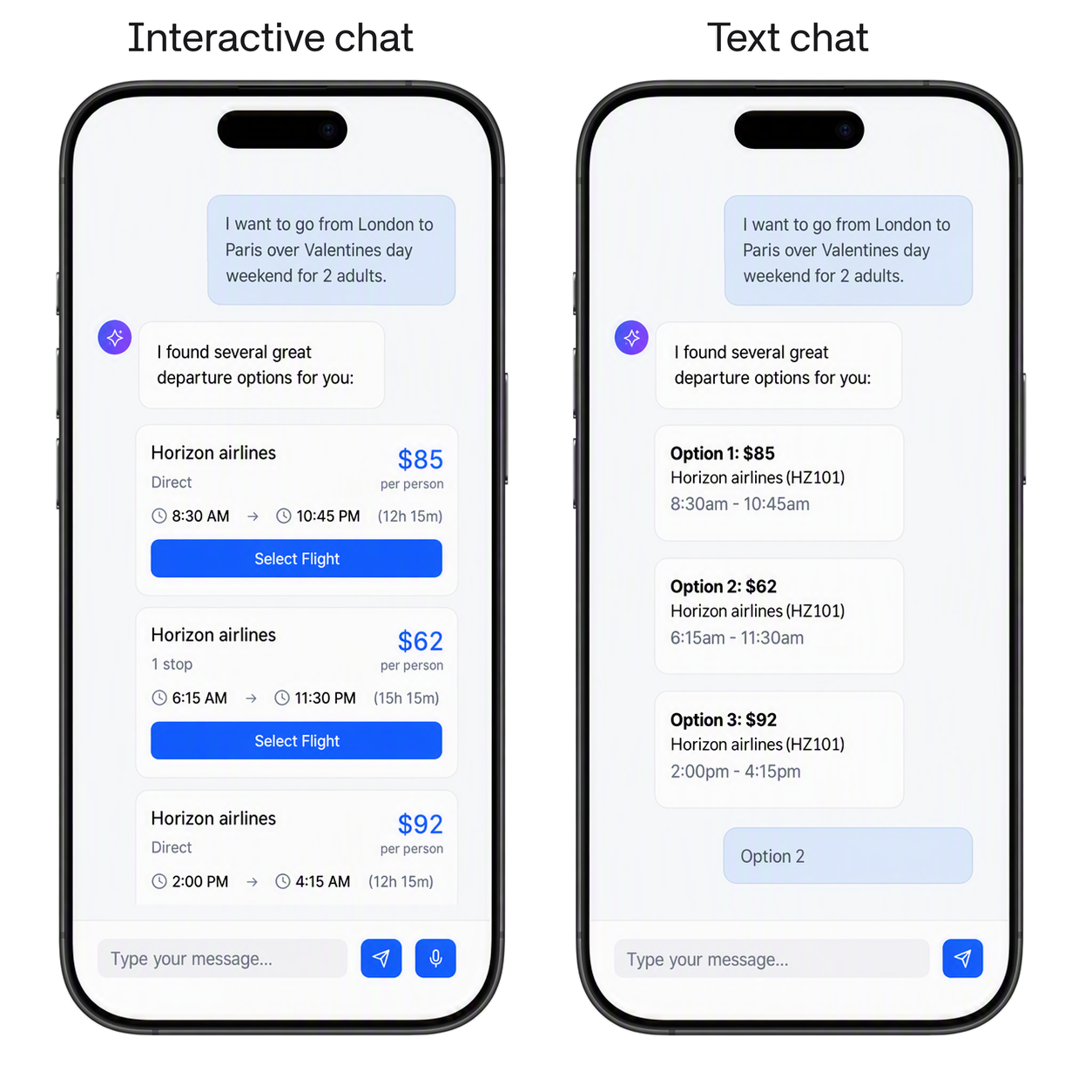
In March 2026, our team conducted a larger survey with 1,031 participants. This time, 70% said they felt comfortable with an “interactive chat,” compared with 66% for a “text chat.”
The difference was modest, but it pointed in the same direction: people were more comfortable when the chat included interactive elements rather than text alone.
How research on generative UI made the preference much clearer
When we began our desk research, there were few studies comparing conversational output with generated interfaces. Google later published research on Generative UI that tested three response formats: raw LLM text, standard markdown output, and a generated UI.
The researchers collected pairwise preferences from human raters across 100 prompts. The resulting ELO scores1 were:
| Format | Elo score |
|---|---|
| Generative UI | 1736.2 |
| Generative Markdown | 1437.7 |
| Generative Text | 1173.7 |
1 Elo score is a method for calculating the relative skill levels of players, originally designed for rating chess players. It can also be used to compare one solution against another.
The pairwise results were even clearer. Participants preferred Generative UI to raw text 97% of the time and to markdown 90.6% of the time.
This was strong evidence that people would rather interact with richly structured information than read a plain text response. But another question was still open: Why would travelers prefer typing in a chatbot rather than clicking in a UI?
The type of task makes the difference
To support the design direction of Amadeus Max for Travelers, we wanted additional data from the industry to be conclusive.
A 2021 study offered the distinction we were missing. Researchers asked students to complete travel-booking tasks using either a familiar interface or a chatbot designed for an airline-booking scenario. While a lot has changed in the AI landscape since then, the fundamentals of booking a flight via a chatbot are still the same.
Among the participants, 88% had previous experience booking travel, while only 25% had used a chatbot for travel planning.
Three results stood out:
- For open-ended tasks, where participants could choose airports and budgets, satisfaction was higher with the chatbot.
- For closed tasks, where airports and budgets were fixed, satisfaction was higher with the familiar interface.
- The chatbot required more cognitive effort than the familiar interface.
This was more useful than a general claim that people prefer interfaces to chat. Chatbots can help travelers navigate complex decisions, even when the interaction pattern is unfamiliar.
That matters in travel. Choosing a trip often means balancing destination, price, dates, schedules, and other constraints. Conversation can help people express needs that do not fit neatly into predefined fields. Once the task becomes clear, however, a familiar interface may offer the easier path forward.
Our prototype made the behavior visible
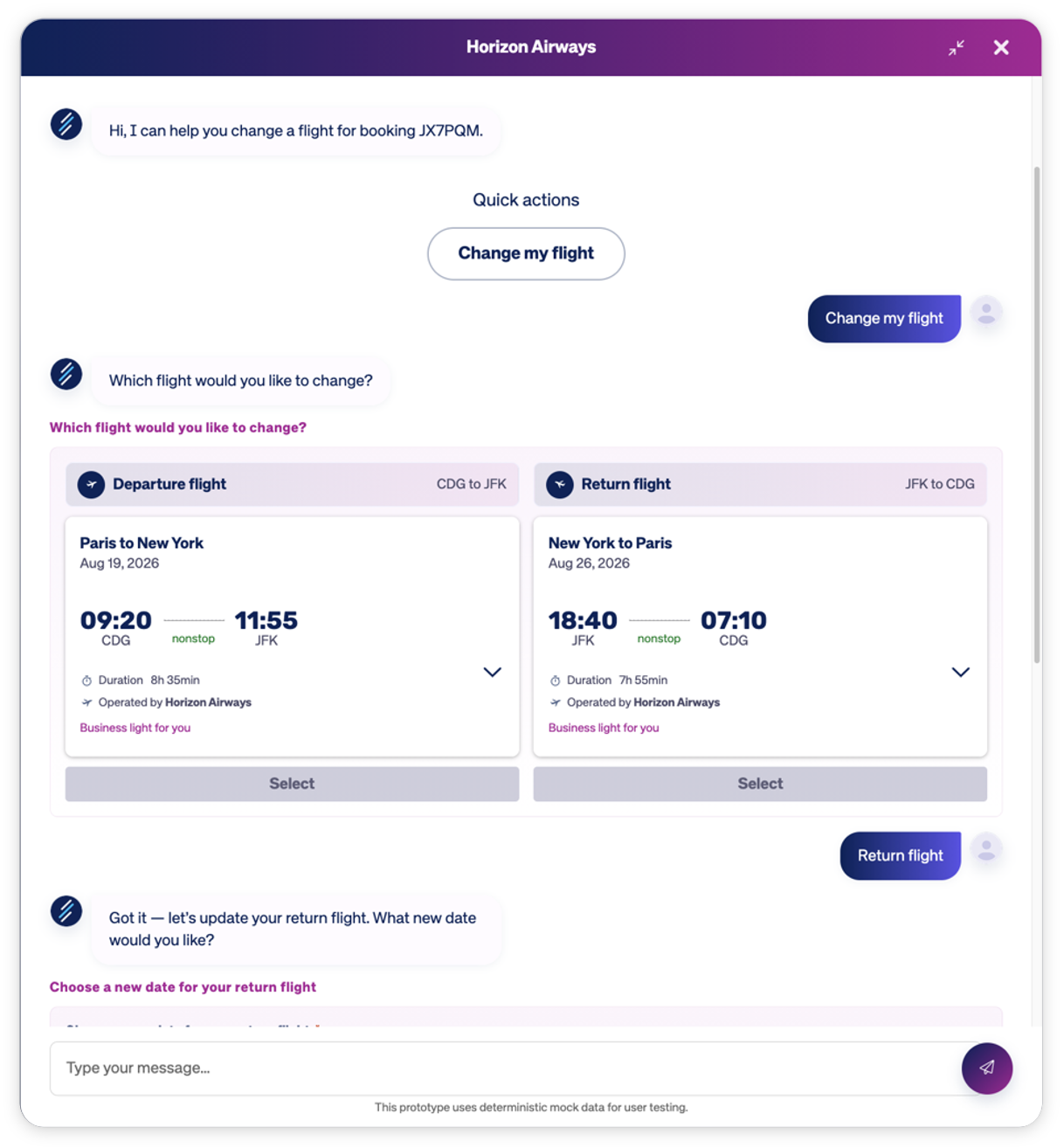
We tested this idea in a prototype study with six leisure travelers in May 2026. Their task was to rebook an existing flight— a mostly closed process, apart from selecting a new date.
Participants could type anything in the chat. They could also use familiar, predefined UI components generated in response to their previous interactions.
From conversational UX to decisional UX
A positive AI agent experience should meet travelers where they are:
Need to explore options, navigate complex decisions, or provide missing information?
→ Typing in the chat is their best option.
Need to follow a streamlined process?
→ Using the generated UI is the easiest.
Our prototype was not simply a conversational UX. It was a decisional UX: each interaction helped travelers make the next decision, one step at a time.
The chatbot is not about typing. It is about understanding travelers' intent and fulfilling it with the least friction, combining conversations and UI components in a single experience.
What this changes for agentic travel products
Discovery research is always exciting. Traveler’s expectations and habits are shifting very fast, and we need clear data to make good design decisions.
We gathered several pieces of evidence pointing in the same direction: chatbots help travelers navigate complex decisions, and when paired with familiar UI components, they combine the strengths of conversation and familiar interfaces to create an optimal experience.
As chatbots become more capable, the competitive advantage will not come from conversation quality alone. Conversation is best for ambiguity and exploration. Deterministic UI is best once intent and constraints are known.
What’s next for AI chatbots in travel?
One practical way to apply this is to look at each traveler journey (rebooking, disruption recovery or, first booking, etc.) and consider which steps are exploratory and which are more deterministic. Conversation can then support the moments where travelers need to express intent or explore options, while validated UI components can help make the next steps clearer and easier once the path forward is known.
In that sense, this research reflects a broader Amadeus view of AI: Technology matters most when it is applied to the right business problem and embedded into real products, workflows, and trusted travel infrastructure.
For Amadeus, AI is not a separate story, but a way to support better decisions, more efficient journeys, and improved experiences across the travel ecosystem, at scale and with integrity.

TO TOP