








From silicon to cloud: Amadeus’ path to efficient, sub-second flight search


In this article...
- What it takes to deliver faster and more efficient flight search at global scale while managing billions of search requests every day.
- How continuous improvements across software, hardware, and cloud infrastructure are accelerating flight search while increasing efficiency and lowering the computing resource footprint per query.
- Why applying NVIDIA GPU acceleration, the move from x86 processors to Arm-based processors, and more efficient cloud planning are shaping the path ahead for flight search.
Editor’s note:This article also reflects the work of the Amadeus Search & Shopping Performance team including Sebastien Autran, Ludovic Tessier, and Antoine Collier.
Every time a traveler searches for a flight, a large planning problem begins behind the scenes, meaning searching through billions of possible itinerary-and-price combinations.
A single flight search must indeed combine schedules, connections, dates, fares, and passenger requirements while applying up to tens of millions of rules.
At Amadeus, we process around 3 billion flight searches each day – roughly 35,000 per second – across travel sellers and airlines, and demand is continuing to rise. At this scale, traffic growth would normally require infrastructure capacity to increase at a similar rate.
Selecting the best valid combinations is a combinatorial optimization problem – NP-hard in the general case, meaning that the computation required to guarantee an optimal solution can grow very rapidly as the problem becomes larger. Yet from this vast search space, we return between 50 and 2,500 priced offers, typically in a few seconds.
Our objective is to break that relationship: absorb growing demand while reducing the computing resources and response time required for each search, ultimately moving toward sub-second flight search at global scale.
Compounding gains across the full stack
Progress has come from many improvements working together across the system with gains building on one another:
- better compilation
- operating-system tuning
- new processor architectures
- improved algorithms and data structures
- local caches
- machine learning
- more efficient use of cloud infrastructure
This year alone, for example, we significantly optimized the memory footprint of our core search engine, enabling it to run on virtual machines that require 50% less memory per virtual CPU. Once deployed, improvements like this become the new baseline for the next generation of optimization.
The same approach continues today, with new opportunities emerging in processors, GPU acceleration inside the flight-search engine, and cloud resource management.
Getting more performance from every processor
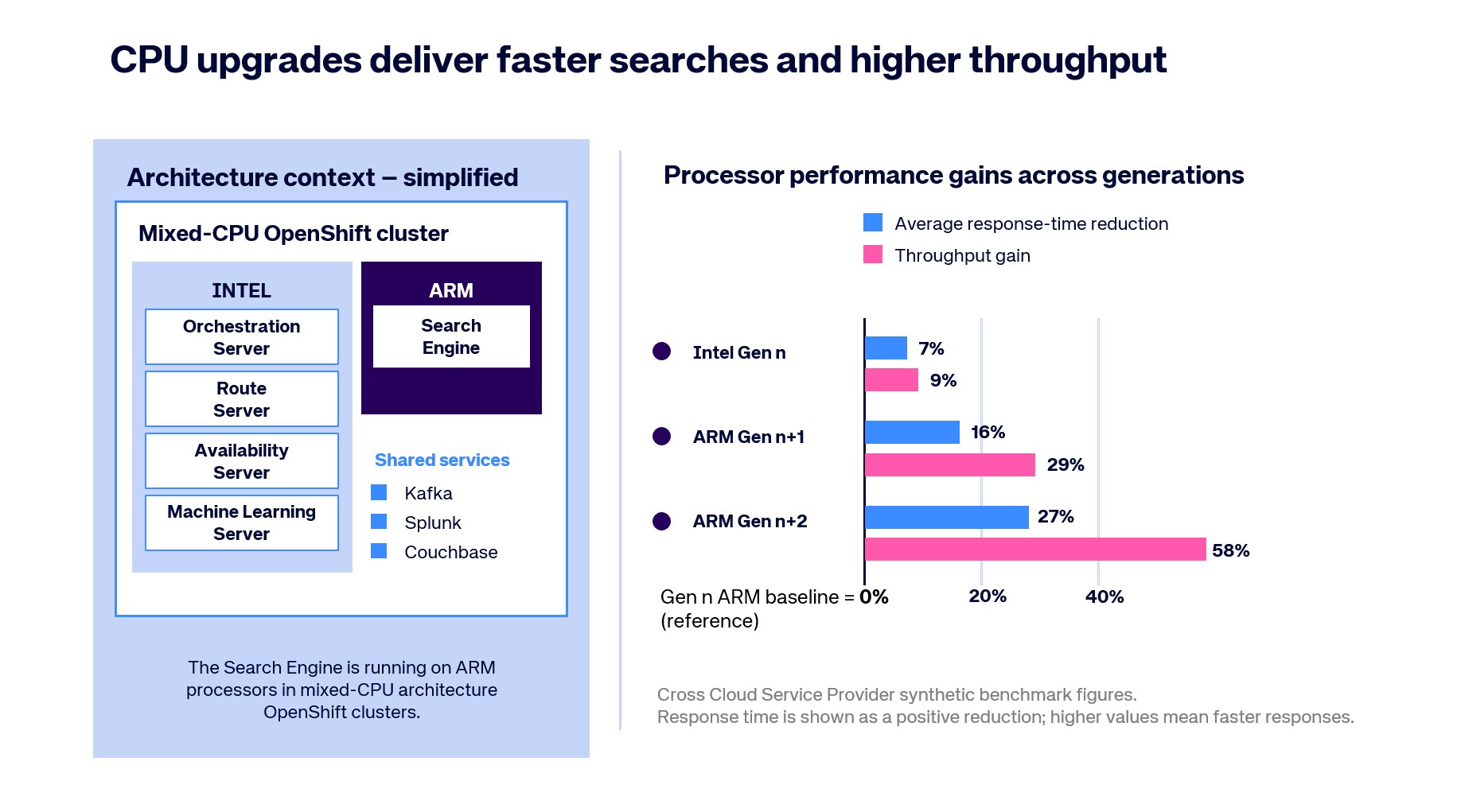
One of our largest structural changes has been moving almost our entire core flight-search shopping engine server fleet from the x86 processors commonly used in servers to Arm-based processors.
This strategic decision was driven by three objectives:
- improving performance for our customers
- increasing operational sustainability,
- and gaining greater flexibility in compute capacity.
Because our flight-shopping platform is a complex ecosystem of libraries, services, and tooling, the porting, validation, and migration effort required close collaboration across dozens of teams across the company. We also worked hand in hand with our technology partners to ensure the entire production stack was ready for Arm, from security tooling to container orchestration platforms.
We were greatly aided in this migration by the immense work done over the years by the whole open-source community, which left only a few bugs and portability issues to iron out on our side.
Today, Arm processors are the primary compute architecture behind our core engine, delivering lasting gains in performance and computing efficiency per search. Early benchmarks of the next generation offered by our cloud providers indicate even greater potential performance gains in the future for our customers.
We are also engaging more closely with our technology partners to share insights into the behavior of our flight-search workloads and to help guide future processor designs toward characteristics that could benefit them most, such as larger CPU cache.
Bringing GPU acceleration into the flight-search engine
Beyond advances in processor technology, Amadeus and NVIDIA recently collaborated to explore how GPU-accelerated computing and travel-specific AI could support faster, more scalable, and more efficient flight search.
As AI assistants and agents increasingly search on behalf of travelers, they are changing both the volume and complexity of demand placed on travel technology.
Through our collaboration with NVIDIA, we are examining how GPU and CPU technologies can improve response times and processing capacity while making more efficient use of computing resources, without compromising the accuracy and bookability that travel sellers and travelers depend on.
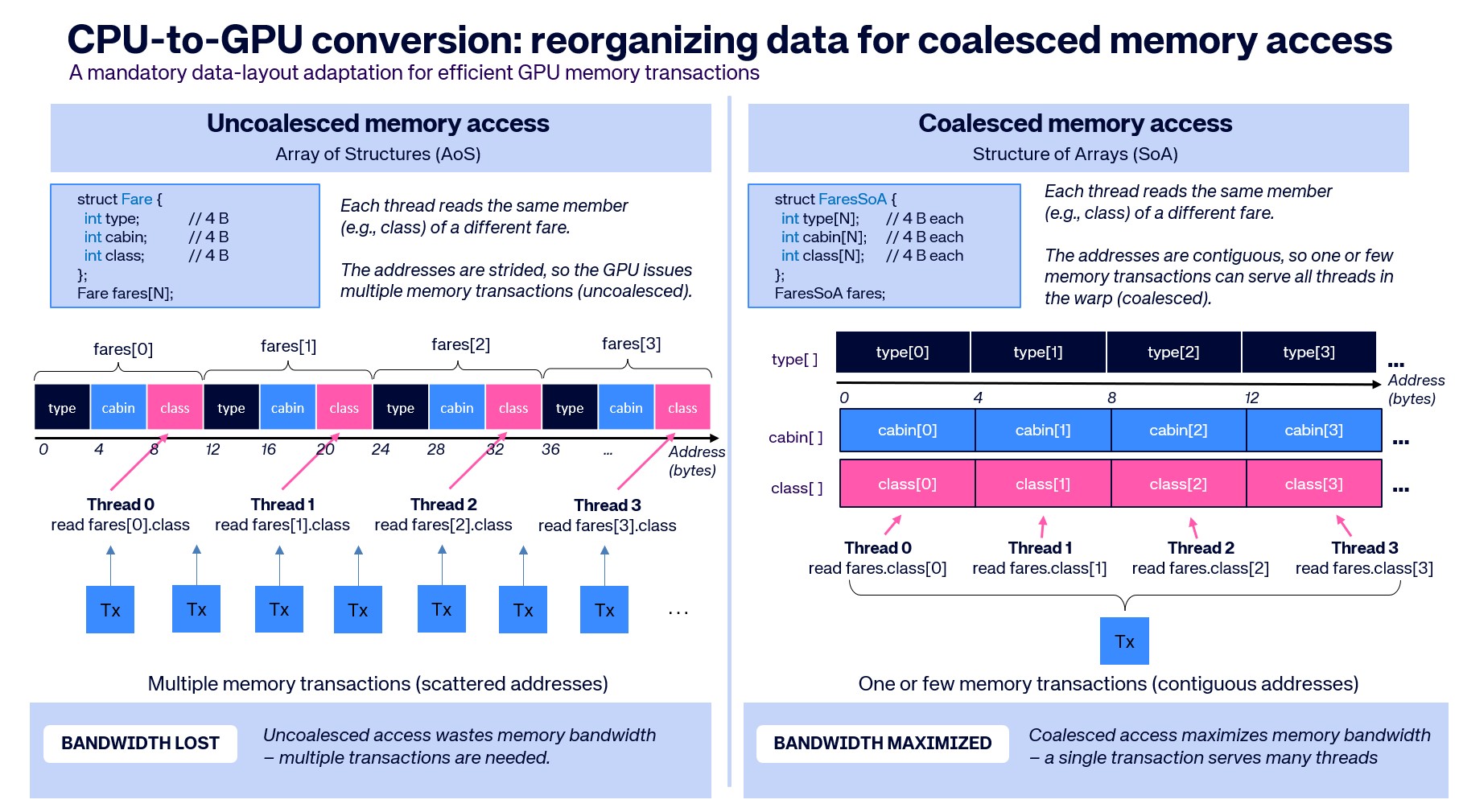
A GPU, or Graphics Processing Unit, contains many computing units designed to execute large numbers of operations in parallel. However, flight search is more difficult to parallelize: different fares and itinerary combinations can follow different processing paths, some checks depend on earlier results, and transferring data between the CPU and GPU may take time.
The key is therefore to identify parts of the engine where parallel execution delivers gains large enough to justify that additional work.
With this in mind, we explored fare-family matching, a representative rules-processing operation in which each fare is tested against many criteria.
On CPU, these checks are evaluated sequentially for each fare. For the GPU implementation, we used NVIDIA CUDA to redesign the nested decision logic and data layout so that thousands of fares could be evaluated concurrently.
Across 40,000 real flight search requests on an NVIDIA H100 GPU, our CUDA kernel reduced latency by a factor of 17 on average. In the most demanding cases, it achieved speed-ups of up to 300 times, processing 10 million fare matches in under one millisecond.
Further optimizations have since improved performance beyond these measurements. Less demanding requests can still see a small latency overhead, as the fixed cost of transferring data to and from the GPU can outweigh the benefits of parallel execution.
These results confirm that GPU acceleration should be applied selectively to operations with enough parallelism to deliver a measurable advantage. They also demonstrate strong performance potential and establish the technical feasibility of the design, while further engineering is needed to make it efficient, reliable, and ready for production at scale.
Going beyond traditional cloud consolidation with GPU planning
Improving flight search is not only about making each query faster. At our scale, it also means using the cloud infrastructure that runs those searches as efficiently as possible.
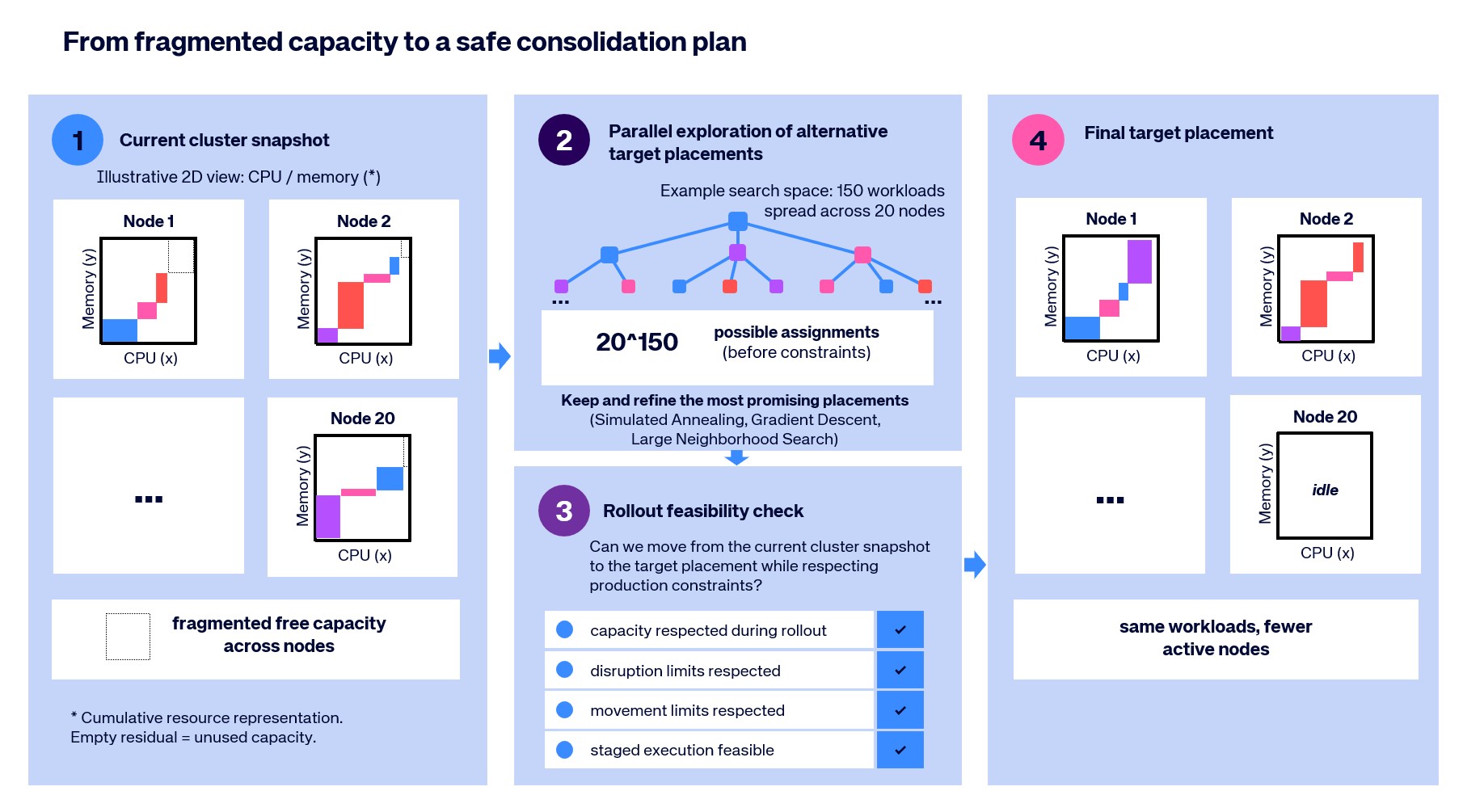
Cloud platforms allocate capacity based on each workload’s resource requests, including CPU, memory, and storage. Over time, these multidimensional requests can become fragmented across machines, leaving unused capacity that is difficult to reuse.
Standard Kubernetes consolidation strategies and commonly studied workload-packing methods can recover part of this capacity. They are most effective in small to medium-sized clusters but provide little improvement at the larger cluster sizes used by our flight-shopping platform. Some other optimization methods can sometimes find better placements, but their planning time quickly becomes impractical at scale.
To go further, we built a prototype planner that uses a GPU-based metaheuristic combining simulated annealing and local descent to explore thousands of promising placements in parallel, while a separate CPU validator accepts only plans that can be executed safely.
Across 864 production-calibrated scenarios, it improved workload consolidation - reorganizing applications to run on fewer active machines and reduce unused capacity – in 89% of cases. The resulting gains could reduce the number of required cloud nodes by up to 5% while maintaining the same workloads and service constraints.
The approach has been submitted to an international conference on optimization and operations research.
The path ahead
These initiatives follow the same approach: improve what is already in production, test new ideas, measure their impact, and industrialize only those that create clear value.
Since 2019, this approach has delivered a threefold improvement in both flight-search speed and efficiency, even as the content we search has become richer and substantially larger.
The next gains will not come from one technology alone, but from combining more capable processors, more efficient cloud infrastructure, targeted GPU acceleration, better algorithms, and tailored system optimizations, from compilers and operating-system tuning to middleware and hardware-resource management.
The destination is efficient, sub-second flight search at global scale.

TO TOP