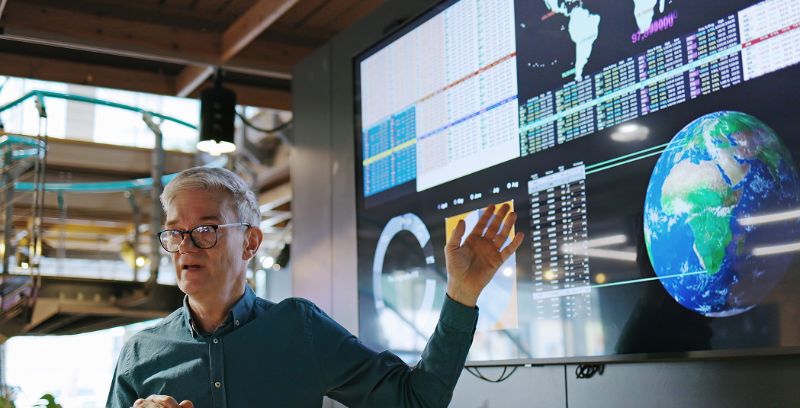








The 3 billion flight search puzzle: How Amadeus is tackling booming search volumes and sustainability at the same time


Amadeus’s Search Technical Team has a lot in common with the British Cycling Team - and that’s good for travelers and the planet at large.
Every day, Amadeus processes approximately 3 billion flight search requests. To give you a sense of scale – Google processes8.5 billion search requests per day. But compared to the average Google search, flight search requests are incredibly complicated to process: for each origin and destination, Amadeus calculates thousands of routes, billions of fares, and trillions of possible offers per passenger. An intricate web of algorithms must work in tandem to respond to a flight search in seconds.
Over the last four years, with the rise of personalization and ancillary options in travel, flight search requests have only multiplied in both volume and complexity, requiring far more computing power than ever before. At the same time, the global energy consumption dedicated to data centers in the world is booming. Data centers aloneaccount for 2 to 4% of energy consumption in large economies like the US, the EU, and China, and as the global reliance on computing power continues to grow, so will the thirst for energy.
Amadeus takes sustainability seriously , so this growth in travel search volume presented us with an interesting puzzle: how do we tackle the growing appetite for travel without growing our energy needs or sacrificing on speed and accuracy?
That’s a question some of the best engineers in the world have been tackling for the last four years at Amadeus. So how did they do it? They followed the same strategy as Sir David Brailsford, the former head of the British Cycling team.
Why engineers at Amadeus have a lot in common with the British Cycling team
WhenSir David Brailsford joined the British Cycling team in 2002, he had his work cut out for him: The team had won only one gold medal in its 76-year history. In response, this former professional cyclist and MBA graduate decided that the team would improve every tiny element involved in cycling – from the individual pieces of each bicycle to the clothing cyclists wore, to the riders’ physical and mental health – by just 1%. Taken together, he gambled that these incremental changes could dramatically improve the team’s performance. And he was right. In the 2008 Beijing Olympics, the team won 7 out of 10 gold medals available in track cycling, and they repeated their performance at the London Olympics 4 years later.
At Amadeus, faced with a daily 3 billion flight search puzzle, the engineering team adopted a similar philosophy. Amadeus engineers investigated each step involved in a flight search: from the application layer to the system or environmental layer, and the hardware layer, to find incremental improvements. Here’s just a snapshot of some of the improvements they made:
- At the application layer: Until recently, every single one of the 3 billion flight searches triggered a cascade of events and calculations in several steps: first, possible flight paths or airport combinations were identified. Then, each flight path triggers a series of fare calculations, which are filtered down to billions of offers for each passenger. To reduce the computing power required, Amadeus engineers trained an AI to learn how to filter out fare recommendations that were unlikely to be helpful. For a trip from New York to Nice, is it reasonable to explore a complex combination of fares requiring stopovers in Toronto and Rio de Janeiro, even if among the cheapest? Unlikely. This dramatically reduced the total amount of calculations and computing power required at later stages of the process. In 2025, 2.5 billion inferences of machine learning models are executed each day to drive flight search algorithmic optimization. All of this significantly improved Amadeus' flight search efficiency and operating costs, while dramatically reducing response time.
- At the system or environment layer: Much like an Olympic cyclist riding a rusty bike, the environment in which Amadeus applications are built and run plays a crucial role in their performance and efficiency. Sir David Brailsford ensured that each Olympic cyclist on his team had their bicycles individually fitted and adapted for their weight and size. Amadeus engineers did the same thing. They customized every component of Amadeus' environment from the operating system to the compilers to create an optimal setting that supports our applications' specific needs and behaviors. For example, they generated a custom binary code to maximize CPU (Central Processing Unit) cache hits. These efforts improved the efficiency of our applications by 40% in 4 years.
- On the hardware layer: Under Sir David Brailsford’s helm, the British Cycling team found lighter tires for their bikes and redesigned their bike seats for more comfort and ergonomics. To improve Amadeus' search applications, the engineer team's focus was on upgrading Amadeus servers. Servers are composed of different components – such as the Central Processing Unit (CPU) or the Random Access Memory (RAM) – which regularly sees performance uplifts in newer generations thanks to the innovation from their manufacturers. They went on a quest to find the very best possible servers to run Amadeus applications, and found that Arm CPUs have promising response time, improved performance, and can use less electricity. That got their attention, but it wasn’t an easy transition. Arm CPUs have different architecture and design compared to the previous CPUs we were using, so they had to change the way Amadeus applications and software operate.
The results speak for themselves
If there were engineering Olympics, Amadeus engineers would be strong contenders for a place at the podium. They increased Amadeus' application efficiency by three times in four years: Amadeus' servers are three times faster, and they use three times less computation power than before for the same volume of travel requests. Amadeus is also now operating part of our shopping applications at scale on cloud-based Arm servers. These new Arm servers use 25% less computing capacity and have a 10% better response time compared to similar server types. Amadeus is probably among the few companies in the world running such complex software at scale on Arm servers in the cloud.

Impact of search performance optimization on Amadeus servers
If there’s one thing that Sir David Brailsford and Amadeus have in common, it’s an understanding that transformational thinking requires an open mindset, collaboration, and creativity. It’s about scaling emerging technologies to develop sustainable, long-term solutions – all while innovating responsibly and to the highest standards. The search optimizations Amadeus has made required deep technical knowledge and expertise and an extreme level of coordination between teams. This was a real feat of engineering that only the brightest and most creative technical minds could achieve.
Most importantly, thanks to these changes, Amadeus is driving very real improvements that will benefit its customers while minimizing the use of energy.
Amadeus technology powers the global travel and tourism industry, and we process some of the highest volumes of search requests worldwide. We take this responsibility very seriously. By working together, we are delivering more open and accessible solutions that are also more energy efficient, accelerating our journey towards a more sustainable travel industry.
TO TOP