









New research suggests AI agents could change how travelers choose airlines and hotels by 2032
The Intelligent Journey 2032 explores four directions travel could take by early in the next decade, and how technology, particularly AI, will connect travelers with airlines, airports, hotels and other travel companies.
The study suggests the future will be defined by travelers deciding what they are willing to delegate, with clear consent, spending limits, and the ability to retain control as key considerations.
It also identifies travel orchestration as the strategic prize for the industry, as AI could reshape travel commerce, and shift value toward those able to coordinate the entire journey across suppliers, payments, identity, disruption and service.
AI is already transforming the traveler journey, helping people discover, plan and navigate their trips.
The question is how far travelers will let AI make decisions for them in the future: booking, paying, changing plans and recovering from disruption.
The next decade could be shaped not by how convincingly AI recommends a trip, but by whether travelers have the confidence in it to see the journey through from start to finish.
That challenge sits at the heart of The Intelligent Journey 2032, a global scenario study by Stratforma and Professor Steven Weber of the Graduate School, UC Berkeley School of Information, commissioned by Amadeus.
Four ways journeys could change by 2032
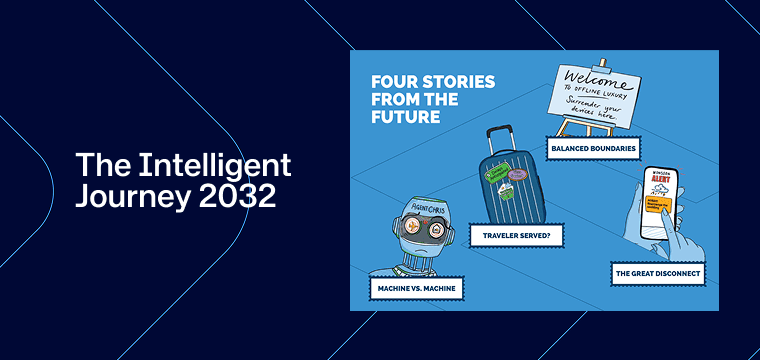
The study explores four possible futures for travel in 2032.1
- Traveler Served? AI works behind the scenes to make journeys smoother, but people remain cautious about letting it take control.
- Machine vs. Machine. A traveler's AI agent interacts directly with the AI systems of airlines, hotels and other providers, changing how options are discovered, compared, and decided upon, with wider implications for branding and loyalty programs.
- The Great Disconnect. Some companies are ready to serve travelers through AI agents; others fall behind, creating a new divide in the travel experience.
- Balanced Boundaries. AI has become increasingly capable, handling the complexity of travel in the background, while people reclaim choice, spontaneity and human connection.
What this could mean for travelers
- Travelers will need to decide how much control to delegate. Clear consent, spending limits and the ability to retake control will need to be understood and calibrated by service providers acting on the traveler’s instructions across the journey.
- AI agents will need a verified digital identity and wallet, proving who they represent, what they are authorized to buy, and which rules they must follow. Providers, payment services and operational systems will need to verify that authority and act on the same instructions.
- Human expertise could become more valuable not less. By handling routine tasks and coordinating responses when plans change, technology can help people and professional advisors focus on complex journeys, exercising judgment and reassurance when it matters most.
What it could mean for the travel industry
The bigger opportunity is managing the whole trip, not just the booking. AI could shift value toward companies that bring travel services together – from flights and hotels to payments and support when plans change.
- Confidence will depend on how travelers experience services like verified identity, consent and payments, with clear authority over who an AI agent represents, what it can spend and when control returns to the traveler.
- Disruption will be the decisive test. Connecting travel data and operational systems across the ecosystem can help resolve routine issues quickly while enabling better decision-making and reassurance when it matters most.
Previously published Amadeus research adds another dimension. Tailored Horizons surveyed 1,000 travelers, including 500 regular business travelers, and found that 74% have used AI to plan a trip, while only 20% would let it spend within a set budget without further approval. That 54-percentage point gap captures the challenge: people may welcome help planning a trip without being confident enough to delegate control over booking, payment and disruption management.
“In the AI‑era the defining question is how much freedom travelers are willing to give AI to act. Amadeus’ role is to be the foundation behind every trip, connecting the data, payments and operational systems that turn a traveler’s request into a journey that works better. That means orchestrating the whole journey across airlines, airports, hotels and other travel providers, so services work together rather than leaving travelers to bridge the gaps themselves. As consumers increasingly experiment with AI in other aspects of their daily life, it will raise expectations about how it can be used for travel. By helping people make better choices, anticipate problems, and recover faster when plans change, AI can unlock simpler, more personal journeys – with human help when it matters.”
Decius Valmorbida President of Travel, Amadeus

"The most important area we wanted to explore was how much decision‑making people are prepared to delegate to a machine. Scenarios let us evaluate this critical uncertainty without pretending there is one certain future answer. Across every future we examined, the deeper issues that lie behind this uncertainty kept surfacing: can people rely on the technology, does it deliver an enhanced experience, can it prove who it is acting for, and can it deliver when a journey goes wrong?"
Nick Turner Founder and Managing Director, Stratforma

“AI provides new ways to anticipate travelers’ needs and make journeys less complex and more personal. Our opportunity is to bring together our expertise, technology, and partnerships to help customers turn those possibilities into journeys that work – from booking and payment to changes and disruption. We want to help travel businesses respond faster and connect services more easily, giving travelers a smoother experience throughout their trip.”
Sylvain Roy Chief Technology Officer, Amadeus
1 These are scenarios, meant to explore, stress-test assumptions and discover new insights – not predictions of what will happen.
How will AI reshape travel by 2032?
This report explores four plausible future scenarios to help the travel industry navigate uncertainty and consider the choices being made today.


TO TOP