-
Solutions
-
Airlines
-
Airports
-
Border Authorities
-
Corporate Travel & Expense
-
Integrations
-
Travel Sellers
-
-
Payments & e-invoicing
-
 AI at Amadeus
Driving integration, scalability, trust and integrity across the travel industry.
Learn more -

-
-
Support & Training
-
 Already a customer?
Log into My Amadeus Services for product news, learning materials, and customer support.
Login
-
-
-
 Transforming travel with AI
Our partnership with Microsoft accelerates our Cloud journey and unlocks new, AI‑powered innovations that strengthen and elevate the travel industry.
Learn more -
 Landmark partnership between Amadeus and Google Cloud
Learn how this collaboration strengthens Amadeus' multi-cloud approach and AI innovation to improve efficiency, reliability and growth in travel.
Learn more
-
-
-
Trending Topics
-
 Six travel trends that will redefine how we travel in 2026 and beyond
Amadeus, in collaboration with Globetrender, unveils the tech, policy and innovation coming to transform the face of travel.
Discover now -
 Airlines in the agentic age: use cases and ideas for getting started with AI
Built on airline input, with Microsoft support, exploring real AI use cases.
Access whitepaper
-
-
Company
-
About Amadeus
-
Careers
-
Innovation
-
Sustainability
Learn how we’re working to make travel a force for good.
-
 Amadeus Global Report
Gain insights into Amadeus' 2025 business, financial performance, and sustainability.
Read the report -

-
-


There are typically nine stages in an air passenger’s journey, from booking and checking-in to travelling and post-trip. As the traveler moves through this cycle, their mindset alters, as do their emotions and the components that are most valuable to them. Many in the airline industry are building merchandizing and servicing strategies that cater to the unique traveler needs at each of these journey stages.
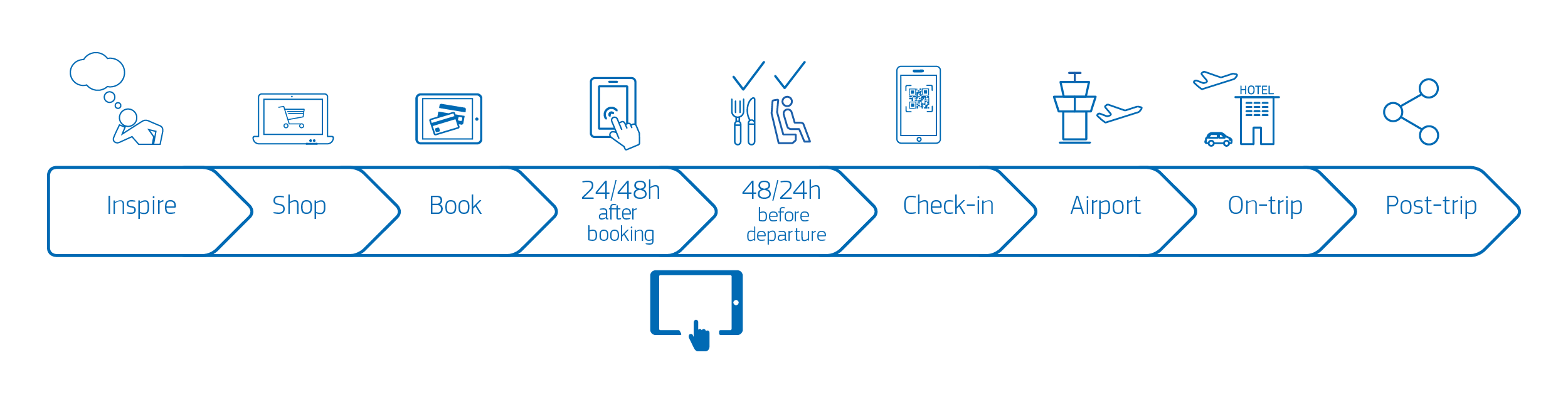
Each journey begins with the inspiration stage when travelers weigh up their travel options before making a decision; this phase is critical for airlines to appeal to those travelers that are not 100% brand loyal. It is followed by the shopping stage, when customers discover their travel options, with many seeking intuitive search functions with personalization. This is followed by the booking stage, which should only take a couple of clicks.
48 and 24 hours before departure, travelers tend to be in ‘planning mode’ and are more likely to purchase last minute add-ons to make their trip more seamless. This is an important stage for airlines, with products such as speedy boarding, extra legroom and lounge access all capable of driving significant revenue when matched appropriately with traveler needs.
During their journey to theairport and to check-in, travelers are focused on the journey ahead, although they may still be open to immediate support and offers from their travel providers such as ground transport, fast-track airport security or parking. These offers are made possible by mobile technology.

Once they have arrived at their destination (on-trip), they are open to targeted, carefully-timed improvements related to the destination: imagine a family traveling to Paris being offered special rates for Disneyland, or a student traveling to New York being presented with concert booking options. And finally, when they have arrived back home (post-trip), there’s an opportunity to build relationships with travelers further by gathering comments and insights that can help to fulfil their future travel needs. If a couple traveled for a honeymoon, can we help make their anniversary special in 12 months’ time?
Adding a layer of complexity to understanding the different stages of this journey is the fact that no two travelers are the same, and the same traveler has different needs depending on the purpose of the trip. What today’s travelers all share is a craving for real-time assistance, for simplification in a world of information overload, and for intuitive services that anticipate their needs before they are even aware of them.
The good news is that 2017 saw a host of industry innovations, many with a focus on digital transformation, to deliver on increasingly unique traveler needs.
For more takeaways, check out ourGlobal Airline Industry Almanac: A spotlight on key trends in 2017 paper here.
TO TOP