-
Solutions
-
Airlines
-
Airports
-
Border Authorities
-
Corporate Travel & Expense
-
Integrations
-
Travel Sellers
-
-
Payments & e-invoicing
-
 AI at Amadeus
Driving integration, scalability, trust and integrity across the travel industry.
Learn more -
-
-
Support & Training
-
 Already a customer?
Log into My Amadeus Services for product news, learning materials, and customer support.
Login
-
-
-
 Transforming travel with AI
Our partnership with Microsoft accelerates our Cloud journey and unlocks new, AI‑powered innovations that strengthen and elevate the travel industry.
Learn more -
 Landmark partnership between Amadeus and Google Cloud
Learn how this collaboration strengthens Amadeus' multi-cloud approach and AI innovation to improve efficiency, reliability and growth in travel.
Learn more
-
-
-
Trending Topics
-
 Six travel trends that will redefine how we travel in 2026 and beyond
Amadeus, in collaboration with Globetrender, unveils the tech, policy and innovation coming to transform the face of travel.
Discover now -
 Airlines in the agentic age: use cases and ideas for getting started with AI
Built on airline input, with Microsoft support, exploring real AI use cases.
Access whitepaper
-
-
Company
-
About Amadeus
-
Careers
-
Innovation
-
Sustainability
Learn how we’re working to make travel a force for good.
-
 Amadeus Global Report
Gain insights into Amadeus' 2025 business, financial performance, and sustainability.
Read the report -

-
-
- Home
- News
- Press releases
- Day of the Dead week 2026: Travel to Mexico City and Oaxaca jumps +32% week-on-week
Day of the Dead week 2026: Travel to Mexico City and Oaxaca jumps +32% week-on-week
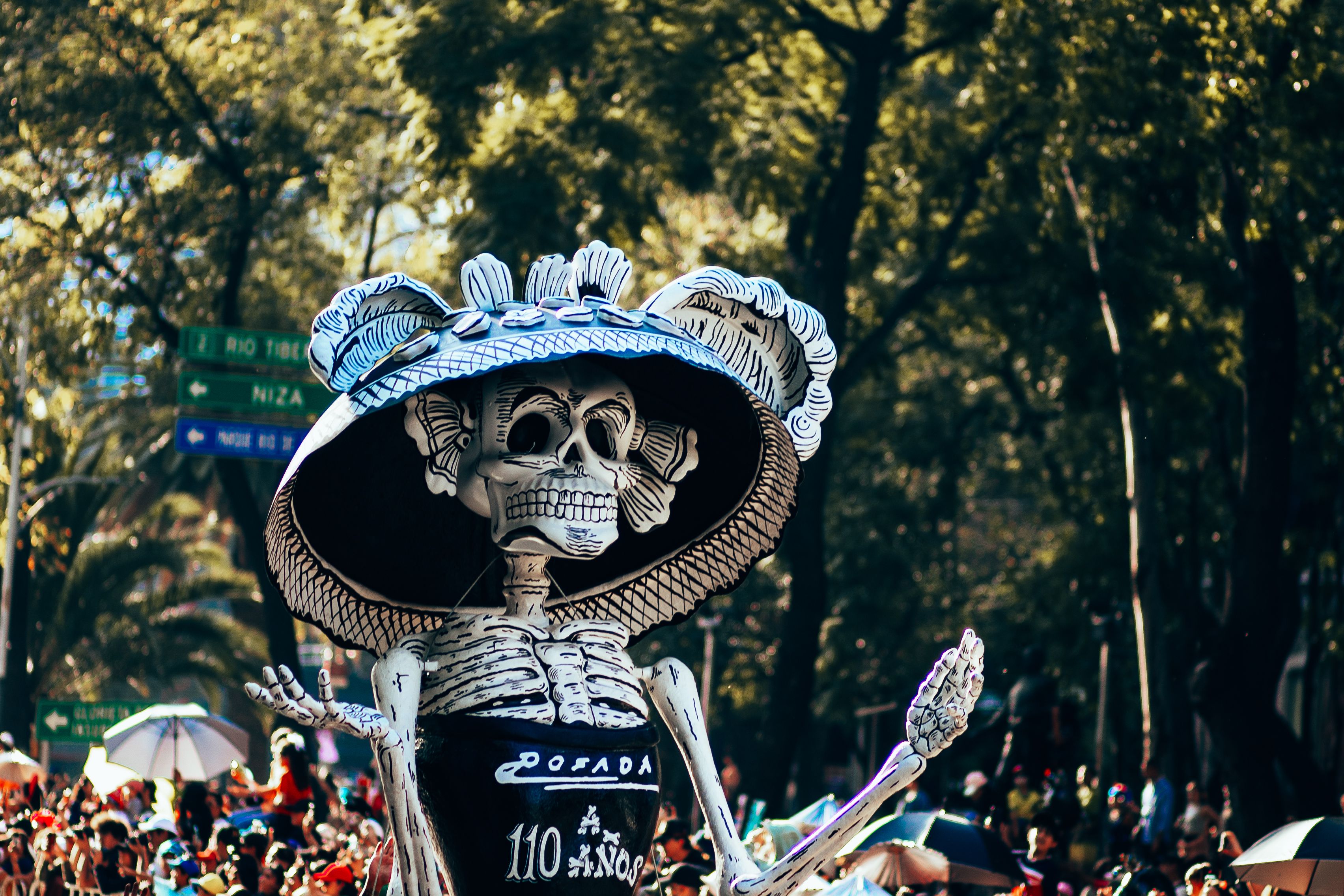

- International arrivals to key Day of the Dead destinations Mexico City and Oaxaca rise +22% year over year
Analysis from Amadeus Travel Intelligence reveals a rise in travel to Mexico around Day of the Dead, or Día de Muertos, with both international travel to Mexico and domestic travel within the country increasing.
Day of the Dead is a Mexican holiday traditionally celebrated on the first two days of November to honor ancestors, although festivities can begin as early as October 28. Often compared with Halloween, it is a unique, Mexican celebration that embraces death as a natural part of life, bringing together family, community and tradition in a colorful commemoration of those who have passed away.
Traditionally, families come together to remember and celebrate their loved ones, with many creating altars, or ofrendas, decorated with photographs, flowers, food and other meaningful objects. In recent years, the festival has attracted growing numbers of international visitors.
Arrivals into Mexico City and Oaxaca accelerate in buildup to Day of the Dead
Mexico City and Oaxaca are particularly renowned for their large-scale celebrations and street festivities, which have featured prominently in global pop culture like the opening sequence of the James Bond film Spectre.
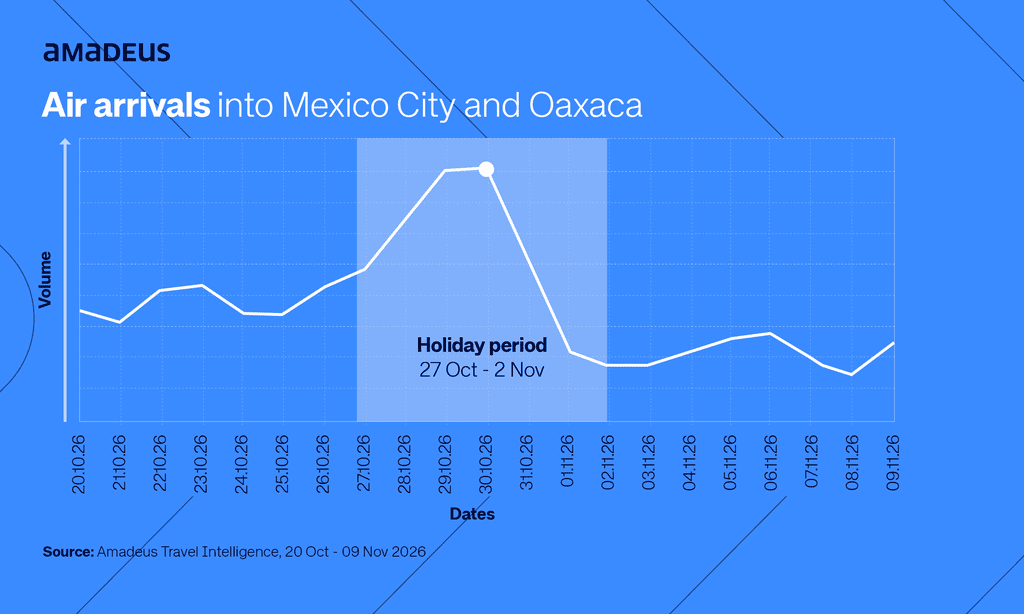
In the week leading up to and over the holiday (27 October to 2 November), the total domestic and international arrivals to Mexico City and Oaxaca are up +32% compared to the week prior (20 to 26 October) and almost double those (up +99%) in the following week (3 to 9 November). Arrivals into Mexico City and Oaxaca peak across 29 and 30 October, ahead of the holiday itself on 1 and 2 November, then fall away sharply.
International arrivals to Mexico City and Oaxaca rise +22% year over year. Duos represents 41% of travelers, followed closely by solo travelers at 37%; together they now account for more than three-quarters of international visitors to the two cities. Within this, medium-length stays (6-13 days) are leading the growth at +31%, followed by short stays (1-5 days) at +18%.
Domestic travelers lead the growth
Domestic air arrivals across Mexico for the festival window are up +24% on last year. Mexico City is the largest domestic destination at 29.4% of arrivals, up +40%, while Oaxaca is up by +49%. The number of solo domestic travelers has increased by +48% compared to the same time last year and accounts for 21.6% of domestic arrivals. Three in four domestic trips (75.7%) last one to five nights.
"What we are seeing with the Day of the Dead festival isn’t a temporary travel trend, but a shift in global travel demand that grows larger every year. Through our data we are seeing that the build‑up to major cultural events and festivals such as the Day of the Dead are just as important as the days themselves. Navigating these spikes and influxes of demand requires a deep, data‑driven understanding of traveler behavior. Relying on intuition or outdated metrics can lead to missed opportunities for hoteliers and DMOs as well as overwhelmed staff and operations."
Jill Boegel SVP of Commercial, Americas, Hospitality, Amadeus

TO TOP