-
Solutions
-
Airlines
-
Airports
-
Border Authorities
-
Corporate Travel & Expense
-
Integrations
-
Travel Sellers
-
-
Payments & e-invoicing
-
 AI at Amadeus
Driving integration, scalability, trust and integrity across the travel industry.
Learn more -
-
-
Support & Training
-
 Already a customer?
Log into My Amadeus Services for product news, learning materials, and customer support.
Login
-
-
-
 Transforming travel with AI
Our partnership with Microsoft accelerates our Cloud journey and unlocks new, AI‑powered innovations that strengthen and elevate the travel industry.
Learn more -
 Landmark partnership between Amadeus and Google Cloud
Learn how this collaboration strengthens Amadeus' multi-cloud approach and AI innovation to improve efficiency, reliability and growth in travel.
Learn more
-
-
-
Trending Topics
-
 Six travel trends that will redefine how we travel in 2026 and beyond
Amadeus, in collaboration with Globetrender, unveils the tech, policy and innovation coming to transform the face of travel.
Discover now -
 Airlines in the agentic age: use cases and ideas for getting started with AI
Built on airline input, with Microsoft support, exploring real AI use cases.
Access whitepaper
-
-
Company
-
About Amadeus
-
Careers
-
Innovation
-
Sustainability
Learn how we’re working to make travel a force for good.
-
 Amadeus Global Report
Gain insights into Amadeus' 2025 business, financial performance, and sustainability.
Read the report -

-
-

Airport passengers have long prized the ability to get from curb to gate as smoothly and quickly as possible. At a time when social distancing and minimizing physical contact have become essential, and security and border checks have become more stringent, this is especiallychallenging.In theory,both requirements could introduce additional friction to the airport experience.
Fortunately, new technology is helping the industry respond.Biometric identityhas the potential to revolutionizetheairportjourney,making it a simple, smooth and document-free experience from check-in to boarding.
With a growing number of airports starting to deploy biometric solutions, many travelers are already starting to see benefits. Here are five:
1. Saying goodbye to manual document checks
By now all travelers are familiar with their airport‘mentalchecklists’ -top of which would rank passports and boarding passes. Easy to lose and yet impossible to travel without, documentation is the single most important itemtoday.
Consider how many timesa boarding passispulled outfrom the traveler’s pocketduring an average airport experience. From check-in to bag drop, pre-security, immigration,duty free,lounge and boarding, paper documents must be kept to handfor at least six separate interactions. For many of us, this has led to moments of panic or frustration searching for a passport buried at the bottom of a rucksack whilst holding up a queueof fellow travelers.
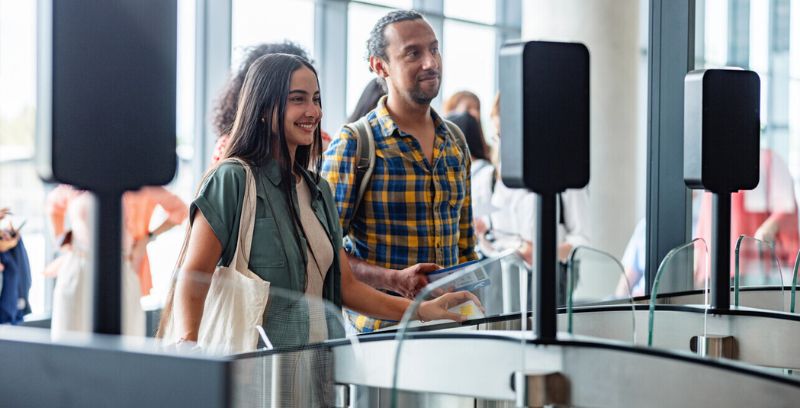
Yet, with an end-to-end biometric deployment itis possible for passengers to navigate the entire airport without taking their handsout of their pockets. When approaching a check-indesk orbag dropunit,their facecan becomeboth their passport and their boarding pass, increasing speed and conveniencewhile avoiding lengthy queues at checkpoints.
2. Simplicity of enrollment
Whether passengers choose to enroll prior to their journey or at the airport, the process is simple and pain-free. On theirsmartphonespassengers can scan their passport, take a selfie and enter their details, after which they will be recognized atservice pointsat the terminal.WithAmadeus,passengers canalternativelychoose to enrollfor biometricsat the airport and complete check-in all in the same, simple, step.
3. Rapid boarding
One of the most noticeable ways in which biometricstransform thepassengerexperienceis during the boarding process.In less thantwoseconds from approaching the gate, they can be on their way to the plane,making queuesand manual document scansa thing of the past.
The process is more efficient, too. In the background the departure control system, which handles all passenger information, is automaticallyupdatedwithout the need formanualintervention.
With biometric solutions already tested and deployed across four continents, theseare also proven benefits. In Slovenia’s Ljubljana airport, the boarding processbecame75% faster.At Fort Lauderdale in Miami,Spirit Airlines now boards passengers in under two seconds;and during a successful trial, Lufthansa completed boarding of an 853 seat A380 aircraft in just 20 minutes.
4. Increased confidence when traveling
Increases in speed and accuracy are welcome, butfrom the perspective of the passengerthismust be married to hygieneand safety-the good news is thatbiometricself-servicecanimproveboth. A touchless experience increasesoverall hygieneand passengers can feel secure in the knowledge thatothermembersof their flight havebeen through the samestringentbiometricidentificationprocess.
5. Smoothing the impact of disruption
Using automated systems also provides the passenger with the smoothest possible experience– even in disruption scenarios. Take the example of a seat or flight changing. As the passenger, there’s no need to locate a help desk, queue up, and print off another boarding pass with the help of an agent. You can simply continue using the same passenger process and self-servicepointsallowing the automated system to do the work.
The benefits of this technology are set to continue in the future too, with the goal of increased passenger personalizationat self-service touchpointsalsowithin sight.In fact, we foresee travelers using biometric identity across the entire trip, to reduce friction when hiring a car or checkingin at the hotel. In each scenario, the traveler can be quickly and reliably identified and that empowers travelers to take greater control of their own experience if they choose.
TO TOP