







Biometrics + digital identity + AI = the future


In this article:
You’re using AI every day, you may have started using biometrics when you travel, you’ve heard about digital identity. But what will happen to the end-to-end experience for travellers when all three start to become orchestrated, in real-time and at scale – and how do we get there? Contributing editor Martin Cowen takes a look.
AI and biometrics are already transformational technologies, but there are compelling arguments that this transformation will become stratospheric when smartphone-enabled digital identity, biometrics and AI combine in truly integrated way, and at scale.
On their own, each can remove friction. Together, they can help create something more significant – a digital identity layer across the journey to form the foundations for a more seamless experience.
Biometrics provides the fast, automated way to confirm that the person at a touchpoint is the right person - replacing repeated manual document checks with near-instant identity verification. Digital identity provides the certified credentials. AI then builds on these trusted identity signals to help systems interpret context and take decisions in real time, supporting smoother passenger flows, stronger security outcomes and more consistent service delivery.
Biometrics and the traveler experience
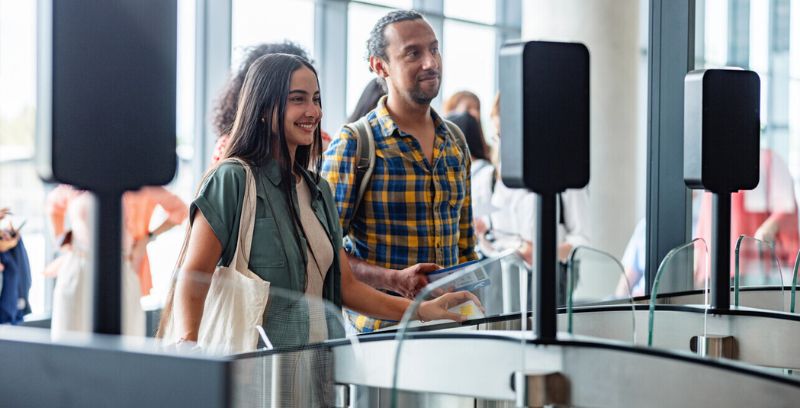
Human beings adopt technologies that make their life easier, and that is what biometrics can deliver. Standing in front of a biometric camera at the border, at the gate, at the lounge, is a lot more user-friendly than scrabbling around looking for your passport, again. It feels a lot more like an experience we should be experiencing in the 21st century as well. Quicker, easier, less stressful. No wonder biometrics is gaining traction.
IATA’s latest Global Passenger Survey (GPS) found that 50% of travellers used biometrics at airports in 2025 – up from 2024 - mostly at the security and immigration touchpoints. Satisfaction levels among users are at 85%.
Looking ahead, as biometrics infrastructure scales, more travellers are likely to share their biometric details – three-in-four (74%) would do so if it meant they could avoid having to show their passport or boarding passes at the required touchpoints.
There are however legitimate concerns around privacy which need attention. Just over two-in-five (42%) of passengers who are reluctant to share biometric data today could be persuaded if data privacy was assured. That points to an important distinction: the barrier is not necessarily the technology itself, but whether travellers understand how their data is being used, stored, shared and deleted.
Converting the sceptics would increase the addressable market significantly, and the most effective way to do this is through frictionless delivery and a visible alignment of purpose between airlines, airports, regulatory authorities and governments. IATA’s GPS found that passengers’ focus is shifting away from general security concerns and looking at data retention and deletion.
Consent from the traveller will power biometrics adoption. The application of biometrics should always be optional with alternatives provided at touchpoints where relevant, like check-in and boarding. Similarly, privacy and security must be at the heart of how solutions are designed. All processes need continuous oversight and need to comply with various regulations and legal frameworks around the world.
Amadeus is also adopting a decentralized approach to its biometrics portfolio, where the traveller remains in full control of their data, which is stored locally in an app on their mobile device, temporarily shared - with consent - to the individual touchpoint, and deleted immediately after use.
All these commitments will coalesce to create a modern, confident digital travel ecosystem where trust, innovation and fundamental rights go hand in hand. Expect to hear a lot about “responsible biometrics” in the coming months and years.
Biometrics isn't hype - it is happening
All transformational technologies tend to be hyped up – blockchain, crypto, augmented reality - until they become established (or not). The hype around generative and agentic AI has transitioned to an acceptance, and while biometrics are less visible than AI, their real-world impact is already significant, in travel – as shown by the IATA data – and sectors such as financial services, healthcare and retail.
Digital identity wallets, which may or may not include a payment component, are not that far behind. The European Union is leading the way, mandating its member states to offer citizens a “safe means of digital identification”. The EU wants 80% of the bloc’s population to have a digital wallet by 2030. Travel is one of the case study use cases, and Amadeus has been a participating partner of the EU Digital Identity Wallet Consortium Large Scale pilot project to help accelerate adoption of the EU Digital Identity across travel, in collaboration with leading airlines such as Lufthansa. Jurisdictions other than the EU are also working on digital identity wallets with a strong travel component – India’s Digital Yatra is one such example.
Biometrics and the travel industry execution
The successful roll-out and mass adoption of biometrics by travellers requires co-ordination and orchestration across all touchpoints, often owned by different entities. In the olden days we used to talk about who owned the customer, then who owned the data. Today, the more important conversation is how that data can be shared responsibly across interoperable systems, in real-time, within the existing privacy and data sharing regulations. There has been a sea-change in enterprise thinking and partnerships are now driving the travel industry forward. No-one can do anything alone anymore – or at least not if they want to be successful.
A recent IATA-organized and Amadeus-supported proof-of-concept offered a glimpse of what this could look like in practice. Passengers were able to store identity documents and a biometric profile in a digital wallet for a multi-leg, multi-airport and multi-airline international journey – fully replacing paper documentation. Other proofs of concept included accepting different digital wallets used by passengers for the same departure, and the use of an airline-branded digital wallet.
This kind of interoperability is critical. Seamless end-to-end travel depends on digital wallets, biometric touchpoints and travel systems being able to work across organisations and jurisdictions. For example, the EU and Indian wallets are both built using global digital travel credentials standards, which will help fast forward the glorious day where there will be interoperability – at scale - between the different government-approved wallets, and this standard has underpinned the cross-border proofs of concept executed by IATA and its partners.
It is important to keep travellers at the centre of these developments. They are interested in interoperability too, even if they might talk in terms of one-stop-shop, the connected journey, or a super-app to handle everything. The IATA survey mentioned above outlines the scale of the addressable market – nearly four out of five passengers (78%) want something on their smartphone that combines a digital wallet, digital passport, and loyalty cards and to book, pay, and navigate airport processes. This confirms that there is demand for products and services built upon the combination of digital identity, biometrics and AI.
Where AI changes the equation
Embedding an identity layer across physical touchpoints can unlock powerful new AI use cases. Biometric systems already use AI, particularly computer vision, to enable matching, while machine learning and deep learning help improve accuracy, speed and security. But the potential goes further.
In a disruption scenario, for example, an AI-enabled travel system could use trusted identity signals to understand where a traveller is in the journey and what services they are entitled to access. Instead of relying on fragmented information, systems could respond with more relevant, timely and personalized support.
This is where biometrics, digital identity and AI become more than separate technologies. Biometrics confirms the traveller. Digital identity anchors the interaction in verified credentials and consent. AI interprets the signals and helps systems make better decisions in real time. Combined well, they can turn identity from a checkpoint into a real-time enabler of smoother, more responsive journeys.
Biometrics beyond the border
There are also strong use cases for biometrics emerging outside of the airport environment, and not just off-airport check-in and remote bag drops.
Amadeus has worked with MSC Cruises at the cruise line’s PortMiami terminal. Guests can register for the MSC For Me app which allows them to enrol for biometrics. This then supports remote check-in, allowing passengers a better embarkation experience through eGates. The cruise line said that embarkation time has been cut by 50%.
The same principles apply across car rental and hospitality – hotels, alternative accommodation and short-term rentals – where biometrics and digital identity can remove persistent friction points. By submitting certified digital documents in advance and completing a facial scan on arrival, travellers can skip manual identity, licence or document checks, sign hire agreements or check in faster. With a biometric match, travellers could access a vehicle, receive a digital room key — or even unlock a hotel room door.
Elsewhere, Amadeus has delivered a friction-free, contactless and secure digital entry experience for Groupe Barrière’s casino in Toulouse, France. VIP members can get to the tables and slots more easily using a self-service biometric gate, which matches their identity using facial recognition technology. This process could be repurposed for any ticketed event, and biometric entry is already transforming live event access and attractions.
Final thoughts
While more airlines and airports are committed to and invested in biometrics, mass adoption will require the wider travel ecosystem to align around interoperability and orchestration. Governments also need to adapt regulations and processes to accommodate the shift from silos to seamlessness.
For technology players like Amadeus, the opportunity is clear: to help the industry harness these technologies responsibly and at scale, connecting the end-to-end journey in ways that make travel more resilient, more sustainable and better for every traveller.
Disclaimer: All opinions expressed are solely of contributing editor, Martin Cowen, and do not necessarily express the views of Amadeus.

TO TOP