
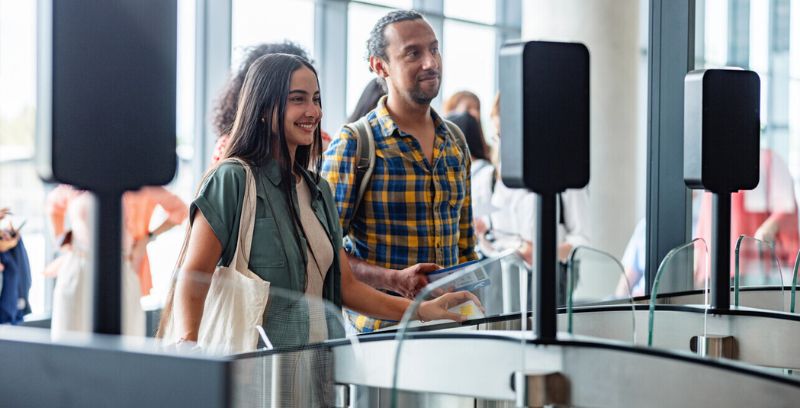









Today, biometrics are best known for reducing queues at border control. But as the hardware and software improves, more use cases to improve the end-to-end travel experience are emerging at other touchpoints at the airport – check-in, bag drop, boarding – as well as within other sectors such as car rental, cruise and hospitality, who are all pursuing the possibilities.
Biometrics really entered the world travel scene in earnest a decade ago. Since 2014 is has become a relevant topic in the travel industry, and the adoption accelerated during the pandemic. Today, facial recognition is the gold standard for digital identification purposes through biometrics.
The technology allows travelers a seamless and contactless experience at the airport, using their face as ID at check-in kiosks, bag drop, or lounge access. Travelers can get on their flight without a boarding pass thanks to a camera by the gate taking a photo, recognizing their ID and cross-referencing with the airline’s departure control system.
Unlocking a smartphone using your face as ID has become a mainstream consumer technology, so it is no surprise that travelers are comfortable using facial recognition on their travels. IATA’sGlobal Passenger Survey for 2023 shows that 75% of passengers prefer biometrics over traditional passports and boarding passes.
Beyond airports, a similar process is being considered by hotels, where mobile check-in has gone one step further and is now a biometric check-in. We talk about your face being your boarding pass – in this case, your face is your room key. But your face can also be your car key, it can unlock your cabin on a cruise ship, or get you into a Taylor Swift concert – the use cases are almost endless, and all great examples of the potential of technology so that the industry is putting traveler’s needs first.
Seamlessness through data – but is it safe?
It’s worth mentioning at the outset that delivering on the potential of biometrics relies on travelers “opting in” to having their image, initially captured for identification purposes, shared with more stakeholders. But whilst travelers have the possibility to opt out, getting the okay from travelers seems not to be an issue. Generally, customers tend to share their personal details if there are clear and obvious benefits – in this case it’s a better airport and overall travel experience, and if they feel they can trust the security and privacy of the data.
The headwind, if any, is how sharing data between citizens, businesses and across jurisdictions is legislated for by national governments. Meanwhile, the dialogue over how data is shared between providers along the travel journey is ongoing. We’re seeing signs that suppliers are more willing to share, realizing that a more open approach to data can benefit the traveler and contribute to a frictionless experience, within the airport environment but also across their end-to-end journey.
This change in attitude is technology-enabled. It is entirely possible – both technically and legislatively – for travelers’ biometric data to be hosted in a secure yet open environment, available to third parties, in a way which is compliant with privacy and data sharing regulations. Open architecture allows ground handlers, departure control systems, on-property retail and more access to data which can improve operations, minimize delays and increase revenues.
Service design at the core
Biometrics provide an enormous opportunity to make every journey better. But the industry also needs to make sure that travelers actually use the biometric options available. Interfaces and communications should be built around “service design”, an approach that looks at how travelers act within the airport environment to ensure that processes – and the technology supporting them – is designed around these observed behaviors.
Travelers have identified that self-service is a key component to a seamless travel experience, and in most cases self-service needs biometrics. The service design is also coming into play here. Self-service travelers, especially those new to the concept, need an interface that gives them the confidence that they have checked in to the correct flight, that their bags are tagged, that their lounge access is confirmed.
To reinforce the frictionless experience, biometric providers also need to work closely with airports on wayfinding, signage, and how check-in and bag drop instructions are communicated in advance and on-airport. Converting travelers who are familiar with usual airport infrastructure to biometrics is a vital part of wider adoption.
There is also little point in offering travelers a self-serve biometrically enabled online check-in if the airport or airline needs to have a member of staff overseeing and approving every transaction at every terminal. Manually checking a self-service process does not contribute to the autonomy travelers want, nor does it provide the additional operational savings and benefits that the airline or ground handlers might reap from biometrics.
Finally, there is also a commercial aspect to it all. Many airports are looking to grow revenues by rethinking the airport as a destination in itself and adding even more services. A seamless check-in frees up the time for travelers to explore the experiences on offer and take advantage of any retail and leisure opportunities on site.
The vision for the future
It is now more than 20 years since I founded Vision-Box, with the goal of redefining the experience of travel and to make every journey better. A goal 100% shared by Amadeus, and now - with Vision-Box being an Amadeus company - we have even better chances of fulfilling our vision and to create a world where the whole journey is connected and seamless and where travel is simplified to the maximum through biometric technology.
Our joint capabilities and leading presence across the biometrics landscape and the travel ecosystem as a whole, inspire us to deliver a seamless, end-to-end integrated traveler experience throughout the airport, centered around passenger processing and self-service. At the same time, it will also deliver outstanding biometrics interoperability to airlines, airports and border control authorities.
Our focus in the near-to-medium term is to grow the reach and awareness of biometrics across the travel ecosystem. Scaling the hardware so that biometrics can support self-service is essential if we as an industry want to reach a tipping point and get to the stage where a seamless airport experience is the norm rather than the exception.
Yet, there is so much more. With air travel volumes set to double by 2040according to IATA , biometrics is a key way that the airport experience can be optimized to cope with even more passengers.
As an example, one of the latest innovations from Vision-Box isFree Flow , launched last year, and recently exhibited at the Passenger Terminal Expo 2024 in Frankfurt. This development replaces gated access at certain touchpoints with wider-than-usual corridors, where AI-based image processing and tracking technology is deployed at scale and captures the image of travelers as they walk through. Based on this, airlines, airports and border forces can identify any discrepancies or inconsistencies among the crowd and take appropriate action for these particular cases, allowing the vast majority of travelers to pass through the touchpoints 100% seamlessly, without needing to rummage through bags for phones or documents to be presented anywhere.
Nevertheless, it is not only a technology game. Better travel starts when the global travel industry is better connected – and the ecosystem stretches beyond the travel industry too. The industry needs to embrace the benefits of sharing data and welcoming more collaboration, and governments and regulators need to be part of the conversation as well. Becoming part of Amadeus means we have more opportunities to foster this industry shift, as well as to accelerate transformation in travel.
Self-service and data-sharing will also help define and bring to market many other use cases for biometrics. Airports and border control might be the priority, but already we are working on connecting the travel experience with smart city initiatives, creating a truly seamless departure and arrival flow, synching facial ID with payment providers, and more.
With this, and the traveler always remaining center stage in the biometrics revolution, the possibilities for biometrics open up and the benefits can be shared across the ecosystem; improved security for governments, reduced costs for airports, enhanced customer service for airlines – and a truly frictionless experience for travelers.
Amadeus completed the acquisition of Vision-Box in April 2024, after the deal received all necessary regulatory approvals in all relevant markets.
TO TOP