









What will my next journey look like?
This is a key question for travelers as the world begins to open up in the wake of COVID-19.
There is no simple answer. Journeys are complex and depend on many factors: the rate at which different countries ease restrictions; government protocols and regulations; and new hygiene and safety standards.
However, as I have explored inprevious blog posts , a number of touchless technologies such as biometrics, artificial intelligence, and digital identity management are coming together at the right moment to change the nature of our journeys. These are not necessarily new innovations, but the pandemic has accelerated their adoption across the travel industry.
Innovations in searching and booking
All travel begins with the search and booking phase. First, we must consider what kind of changes we can expect to see here in the coming months. We are in a fast-moving situation: travel restrictions will remain fluid, often altered with little notice. Navigating which countries have changed restrictions; what standards the hospitality industry has implemented; and what local regulations mean for social distancing all adds to the complexity.
This is where artificial intelligence can help. After obtaining customers’ full consent, companies can work together to share information to get to know their customers’ preferences better; and by quickly sourcing and accessing data and information from travel providers, sellers, and destinations, search will become more open and less linear, more intuitive, more personal, and more informative than ever before.
We are already seeing traveler preferences changing as a result of the pandemic. Searches have significantly changed, as people who might normally be searching for a long-haul holiday may now be looking for holiday destinations you can reach by car or on a short-haul flight. Our travel audience team is working with DMOs around the world to help them utilize these kinds of insights from search data to better understand travelers' demands.
Equally, new innovations in payments such as instant credit and payment by instalment can help instil confidence in travelers. By providing an option to spread out the cost of a trip over a number of months large upfront payments are reduced for travelers.
In asurveywe completed this year, this proved immensely popular with younger travelers, but also with two-thirds of all age categories. These innovations could prove even more popular as travelers look to de-risk their travel choices.
Touchless technologies in the pre-journey phase
However, among the concepts that are redefining the industry, touchless travelis perhaps the most crucial. For many consumers during the lockdown period, touchless technologies became the main way they accessed goods and services, whether that be through contactless payments or the swipe of a mobile app from the safety of their homes.
We are already seeing the impact of touchless technology in China – the very first country to impose a lockdown – and the first to re-open travel. Indeed,CapGemini has explored how Chinese brands and retailers have embraced the concept of touchless retail. There are lessons here for the rest of the world, and I expect others to follow China’s lead.
But while touchless retail can certainly help when it comes to booking travel, particularly in retail travel agents, the major points of contact arise on the journey itself, particularly when arriving at, or travelling through the airport. Here the touchless concept can reassure hesitant travelers.
Indeed, it can be applied even before the traveler reaches the terminal. With cloud technology, both baggage and travelers can now be checked in from their home, hotel, or workplace. And as social distancing at airports remains in place, ‘off-airport check-in’ will be crucial to maintaining a smooth flow of passengers through the terminal.
The Australian ground handler, OACIS (Off Airport Check In Solutions), has been in operation now for three years. The company uses Amadeus’ cloud technology tocheck-in passengers and handle their bags remotely in Australia and New Zealand. We can expect adoption of this technology to be fast-tracked around the world.
Touchless travel and the airport experience
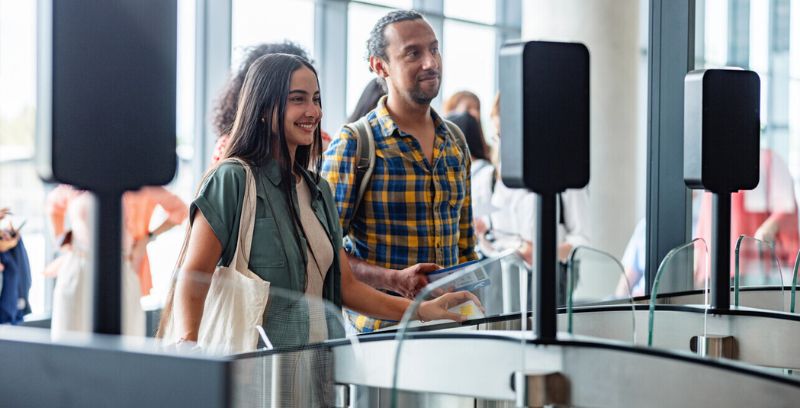
Upon arrival to the terminal, automated devices and biometrics will help streamline the passenger journey to reduce congestion, while low-touch interfaces will minimize touchpoints. At Amadeus, we have partnered with Avinor, the firm that operates Norway’s 44 state-owned airports to introduce acontactless check-in and bag drop . The touchless technology allows passengers to check in for a flight remotely, receive a boarding pass barcode on their mobile phone which can also act as a coupon to print the bag tag, providing a touchless check-in experience.
I can envision a scenario in the near future where a passenger simply walks through security, boarding gates, and the lounge without the need to interact with physical interfaces or present ID.
At Amadeus, we understand the impact different biometric solutions can make. For example, in a pilot at Ljubljana Airport, wereduced average boarding times by around 75% with our solution. By reducing waiting-times and physical touchpoints throughout the airport journey, travelers can expect an altogether smoother and more stress-free journey.
Touchless travel beyond the airport
Even upon arrival at destination, the touchless concept can still be applied. We are likely to see homestays, hotels, and attractions such as museums and theme parks, adopt low-touch solutions. Digital room keys, pre-arrival emails, and facial recognition at concierge are all being explored by the hospitality industry. Indeed, touchless technology was a key pillar in theUNWTO’s global guidelines to restart tourism. We should be considering how these solutions could not only help mitigate the current risks, but future-proof the travel industry for any similar challenges on the horizon.
When we think about the future of our journeys, there is cause for optimism. Because many of the measures we will see put in place to help ease travel back post COVID-19, will also result in smoother and more stress-free experiences, something we can all welcome.
This is the second blog in a 3-part series. You can read more about how to deliver stress-free, safer travel in myfirst blog post, and I’d encourage you to look out for the third and final blog in the series that will look at how innovative technology can act as an enabler in rethinking travel.

TO TOP