-
Solutions
-
Airlines
-
Airports
-
Border Authorities
-
Corporate Travel & Expense
-
Integrations
-
Travel Sellers
-
-
Payments & e-invoicing
-
 AI at Amadeus
Driving integration, scalability, trust and integrity across the travel industry.
Learn more -

-
-
Support & Training
-
 Already a customer?
Log into My Amadeus Services for product news, learning materials, and customer support.
Login
-
-
-
 Transforming travel with AI
Our partnership with Microsoft accelerates our Cloud journey and unlocks new, AI‑powered innovations that strengthen and elevate the travel industry.
Learn more -
 Landmark partnership between Amadeus and Google Cloud
Learn how this collaboration strengthens Amadeus' multi-cloud approach and AI innovation to improve efficiency, reliability and growth in travel.
Learn more
-
-
-
Trending Topics
-
 Six travel trends that will redefine how we travel in 2026 and beyond
Amadeus, in collaboration with Globetrender, unveils the tech, policy and innovation coming to transform the face of travel.
Discover now -
 Airlines in the agentic age: use cases and ideas for getting started with AI
Built on airline input, with Microsoft support, exploring real AI use cases.
Access whitepaper
-
-
Company
-
About Amadeus
-
Careers
-
Innovation
-
Sustainability
Learn how we’re working to make travel a force for good.
-
 Amadeus Global Report
Gain insights into Amadeus' 2025 business, financial performance, and sustainability.
Read the report -

-
-
Fully connected digital mobility services to boost European intercity traffic by 50% and reduce CO2 emissions

A new study from Kearney, commissioned by Amadeus, estimates multimodality could add 500 million travelers and 30 billion euros in additional revenue through 2030, while contributing to make the transport system more sustainable.
Passenger transport is fundamental to Europe’s wealth and social cohesion, that is why the continent has indeed one of the most advanced travel infrastructures. Despite this, travelers looking and planning their trip today cannot easily find all the information and alternative routes and modes of transport. Connections between different travel options and access to travel content and offers is not straightforward. This is frustrating for travelers, while representing an opportunity for the transport industry, as this study on multimodal travel that Amadeus has commissioned with global management consulting firm Kearney has found out.
The study highlights that the development of Digital Multimodal Services in Europe can unlock a pool of 500 million travelers and generate 30 billion euros in additional revenue for Europe’s intercity passenger transport market through 2030. A digital offer visible through all online channels and combining travel by air, rail, or coach for any given journey can provide as much as a 50% boost to the growth of intercity passenger traffic, raising the average annual growth rate from 2 percent to 3 percent. This will be supported mainly by the improved customer experience, as travelers will have more choice to select from different price points and more convenient alternatives The paper also outlines the important role of the European Commission to set up the right collaborative framework through the Multimodal Digital Mobility Services (MDMS) regulation addressing important matters such as access to transport data and interoperability.

Besides making transport more accessible, digitally visible and better connected, the development of the multimodal digital services ecosystem has an additional and important benefit for the transport and travel sectors and Europe as a whole: it can make intercity passenger transport more environmentally friendly and reduce CO2 emissions per passenger-kilometer by 5 percent. This study found out that digitally driven multimodality can help passengers make better-informed choices by comparing the carbon emissions footprint of different travel options, while also offering them improved selection and convenience, leading many people to leave their private vehicles at home in favor of more sustainable travel options.

By removing barriers between modes to provide its citizens and visitors with the world’s first truly multimodal, pan regional system, Europe can future-proof its intercity transport system, offering consumers a quantum leap in the traveler experience and fueling a more decarbonized economy.
If you want to know more about how multimodal travel contribute to a better cohesion, a stronger transport industry and a more sustainable one, download the study in the link below.
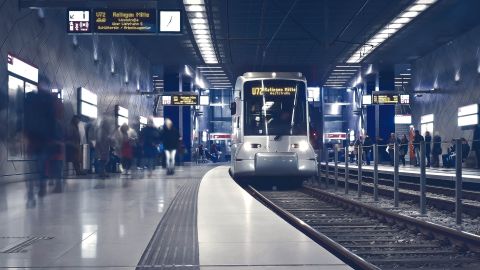
Multimodal digital mobility services
Multimodal digital mobility services can rev up growth of Europe’s intercity passenger transport market by 50 per cent, unlocking a new pool of 500 million travelers.