
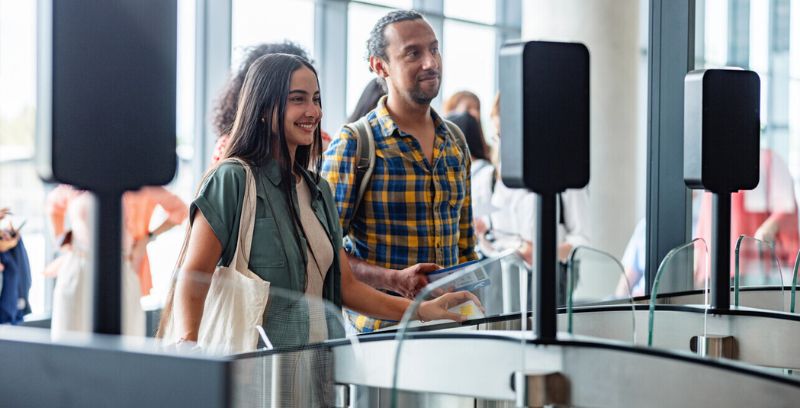









The study, commissioned by Amadeus and delivered by Censuswide, provides encouraging news for the industry, with 41% of travelers keen to book international travel within six weeks of restrictions lifting
The study demonstrates the importance of understanding traveler concerns around privacy, ease of use and security
As governments and the travel industry explore the benefits of digital health passports, the message from travelers is clear: digital health passports can be a vital tool in opening up travel. The study found that just over 9 in 10 (91%) travelers surveyed said they would be comfortable using a digital health passport for future trips.
This encouraging research provides an incentive to accelerate plans for digital health passports that will help to address traveler concerns. The study provided further good news for the industry as just over 2 in 5 travelers (41%) said they would book international travel within six weeks of restrictions lifting, demonstrating that the appetite to travel remains high.
The survey of9,055travelersin France, Spain, Germany, India, UAE, Russia, Singapore, UK and US also contained a note of caution for the industry with over 9 in 10 (93%) travelers having some concerns around how their health data for travel would be stored.
When asked about the receptiveness to storing and sharing digital health data, survey results show:
- Just under three quarters (74%) of travelers surveyed would be willing to store their travel health data electronically if it enabled them to pass through the airport faster with fewer face-to-face interactions
- Over 7 in 10 (72%) travelers surveyed would be willing to store their travel health data electronically if it enabled them to travel to more destinations
- 68% of travelers agreed they would be more likely to share their health data if the airlines they most frequently travel with offered a way to store their travel health data.
Although receptiveness to sharing data is high, the travel industry needs to consider traveler concerns around the use of data. The three main concerns travelers have are:
- Security risks with personal information being hacked (38%)
- Privacy concerns around what health information needs to be shared (35%)
- Lack of transparency and control over where the data is shared (30%).
The survey also explored what solutions might alleviate concerns around digital health data and travel in the future and results showed:
- 42% of travelers said a travel app that could be used across the whole journey would greatly improve their overall travel experience and reassure them their information is all in one place
- 41% of travelers agree a travel app would reduce their stress around travel
- 62% of travelers would be more likely to use an app to store their health data if a travel company partnered with a trusted healthcare company.
The research is the second in a series of traveler surveys, where Amadeus takes a regular checkpoint on traveler sentiment and concerns to help the industry rebuild travel in the most effective way. The2020 Rethink Travel survey revealed how technology can help to increase traveler confidence and Amadeus revisited this question to see how traveler confidence has changed since September 2020. 91% of travelers now say that technology will increase their confidence to travel, an increase from 84% in September 2020.
When asked which technology would increase confidence to travel in the next 12 months, mobile solutions were highlighted as a popular option, with the top three technologies including:
- Mobile applications that provide on-trip notifications and alerts (45%)
- Contactless mobile payments (e.g., Apple or Google Pay, Paypal, Venmo) (44%)
- Mobile boarding (e.g., having your boarding pass on your mobile phone) (43%)
Decius Valmorbida, President, Travel, Amadeus, says, “There is no doubt that COVID-19 will continue to shape the way we travel for the months ahead, just as it influences so many other areas of our lives. Yet while there are still uncertainties, research like this reinforces my optimism that we will build back travel better than before. Collaboration across governments and our industryis the key to restarting travel, as we deliver on traveler expectations outlined in this Rebuild Travel digital health survey, deploying the right technology to enable a truly connected and contactless journey.”
Christophe Bousquet, CTO, Amadeus, comments, “This study highlights once more the key role that technology will play in rebuilding travel. We’ve seen a shift since our last survey, as travelers now place more focus on mobile and touchless technology, crucial areas that will clearly strengthen traveler confidence. It’s also very relevant to see that travelers are open to digital health passports and sharing their data as they move through the journey, once the right safeguards are in place. At Amadeus, we’re committed to rebuilding a better industry, together with our customers and partners.”
To gather more insights into how the travel industry can rebuild, Amadeus, a global leader in travel technology, commissioned research to learn more about travelers top concerns around digital health data, their comfort levels with sharing and storing their data, and the solutions that may help to alleviate their concerns for future travel. To learn more about the results of the survey,read our global and country reports and infographics here.
Research methodology
The survey was conducted in late February 2021 by global insight-driven research firm Censuswide to explore traveler sentimentin light ofCOVID-19 towards digital health data and technology to help rebuild travel. The findings were based on 9,055 respondentsresiding in France, Germany, Spain, UAE, Russia, India, Singapore, UK and USwho have traveledabroadin the last 18 months (witha minimum of1,000 respondents per market).Fieldwork was carried out between 18th – 26th February 2021. Censuswide abides by and employs members of the Market Research Society which is based on the ESOMAR principles. For reference: Generation Z =16-24 yearolds; Millennials = 25-39 yearolds; Generation X = 40-54 yearolds; Baby Boomers = 55-74 yearolds; 75+ Silent Generation
TO TOP