-
Solutions
-
Airlines
-
Airports
-
Border Authorities
-
Corporate Travel & Expense
-
Integrations
-
Travel Sellers
-
-
Payments & e-invoicing
-
 AI at Amadeus
Driving integration, scalability, trust and integrity across the travel industry.
Learn more -

-
-
Support & Training
-
 Already a customer?
Log into My Amadeus Services for product news, learning materials, and customer support.
Login
-
-
-
 Transforming travel with AI
Our partnership with Microsoft accelerates our Cloud journey and unlocks new, AI‑powered innovations that strengthen and elevate the travel industry.
Learn more -
 Landmark partnership between Amadeus and Google Cloud
Learn how this collaboration strengthens Amadeus' multi-cloud approach and AI innovation to improve efficiency, reliability and growth in travel.
Learn more
-
-
-
Trending Topics
-
 Six travel trends that will redefine how we travel in 2026 and beyond
Amadeus, in collaboration with Globetrender, unveils the tech, policy and innovation coming to transform the face of travel.
Discover now -
 Airlines in the agentic age: use cases and ideas for getting started with AI
Built on airline input, with Microsoft support, exploring real AI use cases.
Access whitepaper
-
-
Company
-
About Amadeus
-
Careers
-
Innovation
-
Sustainability
Learn how we’re working to make travel a force for good.
-
 Amadeus Global Report
Gain insights into Amadeus' 2025 business, financial performance, and sustainability.
Read the report -

-
-
- Home
- News
- Press releases
- Hamburg Airport streamlines approach to IT by selecting Amadeus cloud technology
Hamburg Airport streamlines approach to IT by selecting Amadeus cloud technology

- Move to Amadeus Flow helps the airport and its airline partners simplify every aspect of passenger services technology
- More than 200 workstations switching to innovative Amadeus’ Cloud Use Service
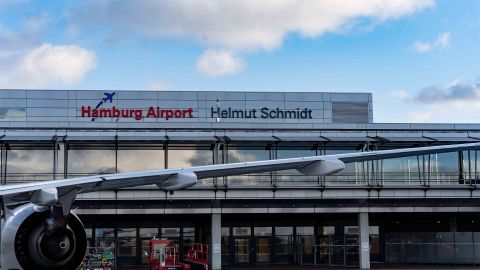
Hamburg airport, the fifth busiest airport in Germany serving more than 100 European and long-haul destinations, is committed to modernizing its approach to technology in order to offer the smoothest possible passenger experience based on an efficient model.
It’s against this backdrop that Hamburg airport has selected and implemented Amadeus Flow, the company’s integrated airport cloud solution to manage passenger services end-to-end, providing a flexible approach to passenger services technology. By moving more than 200 workstations to the cloud with Amadeus Cloud Use Service (ACUS), ground handling agents will be able to easily and reliably access any airline system they need at key service points like check-in, boarding, and lost & found desks.
The primary driver behind this new installation of a common use system is a simplified approach to technology. Moving to the new cloud service allows Hamburg Airport and airline partners to replace multiple costly, fixed network connections with robust internet links. It also means that the airport no longer needs to host and maintain airline systems locally on its own servers. Taking this flexible cloud approach to IT reduces costs and frees the airport to focus on other priorities.
The modern cloud technology also allows the airport to consolidate information from across the passenger’s journey easily and in a consistent format. This aggregated data will be used to power intuitive dashboards that help the airport become insight-driven to better match resources to demand and to proactively identify issues in passenger services.
Passengers will also be able to quickly and easily pay for airline products at key service points thanks to the introduction ofOutpayce Airport Pay . When paying for ancillary services like extra baggage, meals, or upgrades, passengers will be able to pay using a wide range of cards and mobile wallets such as Apple Pay or Google Pay.
Martin Fritzsche, Team Leader Systems Aviation Development, Hamburg Airport said: “Replacing Common Use infrastructure is a major decision for any airport. Following a rigorous tender process, we are confident that Amadeus’ cloud technology will significantly simplify our approach to IT. This upgrade will contribute to a smoother experience for our airline customers and their passengers.”
Yannick Beunardeau, Senior Vice President Airport & Airline Operations EMEA, Amadeus added: “The move to the cloud is accelerating as more airports recognize that a simplified approach helps to lower costs and increase the pace of innovation. If airlines decide to add new passenger service ideas at Hamburg in the future, like payments, it will now be much quicker and easier for them to do so.”
The agreement also sees Hamburg Airport adopt Amadeus Smart Message, a modern internet protocol message exchange, to replace costly legacy baggage messaging system across the airport.
TO TOP