







Emerging Trends in Business Travel for 2025


Trends in business travel come in many guises, with some common themes vying among the outliers for attention and analysis. Contributing editor Martin Cowen takes a look through the Amadeus lens.
The topline findings from GBTA’s first Business Travel Outlook Poll of 2025 were positive in many respects. Nearly half (48%) of the c750 buyers expect more business trips to take place in 2025 than 2024, with 57% anticipating increased travel spending.
This synchs with its Business Travel Index Report which predicts a spend of $1.6 trillion in 2025, around 10% up on 2024.
That’s a lot of business for top-tier TMCs and their blue-chip clients, a big opportunity for smaller agents to work with SMEs, not forgetting the unmanaged but cumulatively significant needs of micro-businesses and sole traders.
Amadeus has a footprint across all of these business traveler segments, and its trends for 2025 reflect this overview.
Agentic AI and biometric gateways
Many articles talk about Artificial intelligence (AI) as a trend, but AI has been around for ages. Amadeus is very specific and talks about “agentic AI”.
Agentic AI, according to Nvidia, “uses sophisticated reasoning and iterative planning to autonomously solve complex, multi-step problems”. Travel is a great use case for agentic AI and also a testing ground. It is a work in progress but is arguably more enterprise-friendly than generative AI and less prone to mistakes, or what are now known as hallucinations .
This is because AI is only as good as the data it ingests. When the data comes up short, so too do the AI-generated responses.
In a business travel context, the Amadeus Cytric AI Assistant in development could make it easy for colleagues to quickly match and book travel itineraries in a single, sophisticated workflow within Microsoft 365 using natural language prompts. This integration could further streamline the travel journey to deliver an intelligent, and contextually aware end-user experience. The Cytric AI Assistant automates bookings and expensing, only “searching” for content that it has been authorized by the corporation. This guardrailing stops it from bringing back results that are out of date and out of policy.
Other takes on the AI trends come from Phocuswire, which focuses on autonomous agents (closely related to agentic AI but not identical). It is one of the few pieces which mentions digital identity. It's interesting that digital identity doesn’t get much of a direct look despite the fact that the EU Digital Identity Wallets – which supports the ability to “store your visas, passports and other travel documents in a digital wallet [and] easily check in to flights and hotels” are coming to the European Union in 2026.
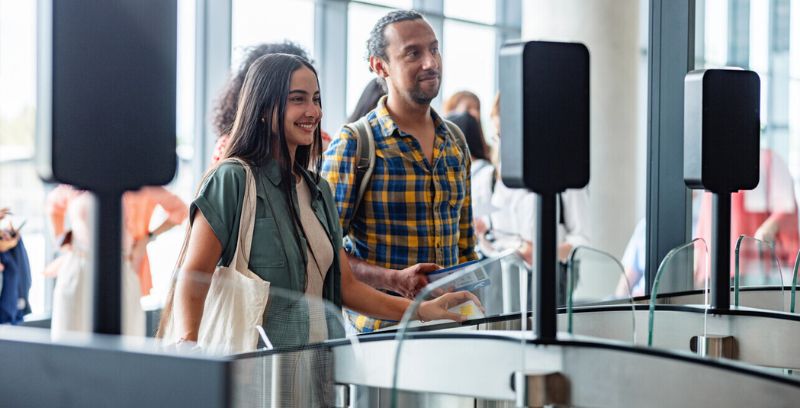
It’s not clear how eIDAS 2.0 will synch with airport infrastructure, so for now we’re looking at biometrics as the enabler of a seamless airport experience. Amadeus has identified biometric gateways – systems leveraging facial recognition and AI to ensure smoother, faster, and more secure journeys through the airport for corporate travelers – as a trend.
Biometrics are already improving some aspects of the airport experience, but not enough for airports to become a destination in themselves. But this didn’t stop booking.com suggesting “the gate escape” as a consumer trend for 2025 , “the year that the airport takes its place in the limelight as travelers actively seek out destinations with the best airports”.

Jetset Hacking, New-Gen Frequent Flyers and Proximity Power
Wellness is an industry worth $1.8 trillion in 2024, according to McKinsey, and there’s a growing emphasis on wellness while traveling, reflected in the “Jetset Hacking” trend.
The wellness trend is relevant to all generations of business travelers. Amadeus introduces Generation Z (younger people born between 1997 and 2012) - as the New-Gen Frequent Flyers. This cohort is “reshaping business travel with their demand for flexibility, sustainability, and experiences that blend work and leisure.”
Whilst this is true, it’s not just Gen Z who are reshaping business travel along these lines. Flexibility in a corporate travel context is determined by the requirements of the business, blended trips also need to be signed off, while sustainability concerns will increasingly be determined by regulatory reporting clients.
It’s worth noting that a lot of leisure trends are changing as a result of the climate crisis, and many of these talk to changes to come for business travel. National Geographic talks about season-stretching and Skift talks about coolcations to describe the trend for leisure travelers to travel off-season because it’s less crowded, not as hot or less likely to flood/catch fire.
As demand patterns shift, so too will the pricing curve. Meeting and event planners who might have had their big meeting off-season because it was cheaper might need to rethink.
Finally, the last Amadeus trend is as relevant to global macroeconomics as it is to business travel. “Proximity Power” describes the growing importance of regional and domestic trips. This observation comes at a time when protectionism and tariffs are having a bigger impact on global trade than at any other time in recent history.
GBTA’s stats at the start of this article do not suggest that the new macroeconomic landscape will hit the demand for business travel, but there will be some implications. Localized supply chains for example will require localized business travel, which might lead to lower carbon emissions if prospects and clients are dotted around the country rather than around the globe.
Conclusion
The Amadeus Cytric Business Travel Trends 2025 focuses on business travel, and it's worth taking a step back and looking at the bigger picture - business travel is increasingly exposed to what’s happening in other parts of travel. The lines between road warriors and holidaymakers started to blur with bleisure, and today there’s a lot happening in the leisure sector which is coming to a preferred supplier agreement near you.
At the same time, business travel sellers and suppliers still need to adapt to changes in the workplace and workforce, changes to the global context, changes to the climate. Perhaps the biggest trend in business travel is that there will always be new, evolving trends.

TO TOP