







Accessible Travel: Making the travel experience better for everyone, everywhere


From the World Sustainable Hospitality Alliance, to the Global Business Travel Association, and the International Air Transport Association – it seems a lot of big industry players are interested in making travel more accessible and inclusive these days.
When you consider that 1.3 billion people have disabilities– that’s 16% of the world’s population! – it becomes obvious why: making travel more accessible is not only the right thing to do, it’s also good for business.
Accessibility in travel goes a step further, in that it can benefit all travelers.
While designed primarily for people with disabilities, accessibility features like ramps, accessible transportation, and plain language information also make travel easier and more enjoyable for everyone, including the elderly, families with young children, and those with temporary mobility issues.
By 2050, 20% of the global population will be over the age of 65. With grey hair, many of us may develop new needs, but that doesn’t mean our taste for travel and adventure will diminish. Travelers with disabilities or reduced mobility are an underrepresented market and their market share will continue to grow as the population ages. Companies that learn to create and promote more accessible travel opportunities right now will have a competitive advantage well into the future.
How Amadeus developed its accessibility ambition
At Amadeus, inclusion has always been a core value and part of our culture: we are a global community of over 20,000 people from 150 nationalities and diverse backgrounds. Our purpose is to make the travel experience better for everyone, everywhere, across all steps of the journey, and we know that people with disabilities are still more likely than most to encounter friction during their trip. In 2016, we published a report called “Voyage of Discovery. Working Towards Inclusive and Accessible Travel for All”. Since then, we’ve continued to look for ways to transform the travel experience to ensure that everyone can search for, book, and experience travel safely, comfortably, and with dignity.
That’s why last year, we launched a comprehensive accessibility assessment to better understand the status of accessibility internally at Amadeus, as well as what was happening in the wider world. We wanted to know the latest trends and regulations, what our peers and customers are doing, and what their needs are as well as those of travelers. We conducted interviews, engaged with various industry associations and organizations, reviewed legislation, and identified best practices. This assessment was crucial in our understanding of where we are, and where we want to be. Ultimately, it helped us identify our accessibility ambitions, and the pillars of our current strategy.
The four pillars supporting Amadeus’ commitment to accessibility
Our commitment to inclusion and accessibility is at the heart of our Sustainability strategy. Our goal is to be an accessible and inclusive company, and a catalyst for accessible travel across the industry by focusing on four areas:
- Providing an accessible workplace for our employees. We strive to create an environment where everyone feels valued and respected, ensuring that all employees can effectively use and access our working environment to thrive.
- Offering accessible technology. We develop solutions that aim to be accessible to the widest range of users, from leisure travelers to industry professionals with disabilities who may use our platforms.
- Developing solutions that facilitate accessible tourism. We would like technology to ensure that anybody that wishes to travel can do so and have the best experience possible, regardless of their accessibility needs.
- Promoting accessible travel at an industry level in collaboration with other industry players.
Accessibility in action: Designing a digital space for all
With the help of employees like Sohail, who is visually impaired and works at Amadeus France, we have been working to improve our workplace design and our corporate booking tool, Amadeus Cytric.
Sohail uses a screen reader to navigate his computer, read emails, and perform other tasks. Screen readers are crucial for his productivity and independence. So, when he has to plan a work trip to the World Travel Market in London, he uses Cytric, like all other Amadeus employees. Since 2020, Cytric is compatible with screen readers like the one Sohail uses to navigate the digital world. Through assistive technology, Cytric has been developed so that accessibility tools such as screen readers can convert text and image content into voice or braille output. We’ve also changed colors, contrast ratios, and font size to make the content easier to read, and we’ve adapted keyboard navigation to build appropriate header structures that are easier to use by those who cannot use a mouse because of motor disabilities.
This is just an example of the work we are doing to ensure that all users can access our solutions effectively. Our ambition is to extend this digital accessibility to other Amadeus products and services.
Accessibility in action: Making airports easier to navigate
Airports worldwide have adopted many innovations to improve accessibility. These include mobility devices, better staff training, and sensory communication solutions such as braille or paging systems. The Hidden Disabilities Sunflower Network, for example, aims to ensure that people with non-visible disabilities are confident to travel independently knowing that they will receive the support that they need at every stage of the journey. From arriving at the terminal to boarding the flight, the flight itself and arriving at their destination. This initiative has gained significant traction since its inception at Gatwick Airport in 2016, now spanning to 300 airports in over 30 countries, and 18 airlines worldwide.
At Amadeus, we are helping airports improve their customer service with self-service check-in devices and biometric technologies that meet the high accessibility standards set by international bodies.
At check-in, for example, our self-service check-in kiosks have tactile buttons, options adjustable text sizes, and screen-reader technology. Plus, these kiosks can be positioned to facilitate easy access for mobility aids such as wheelchairs. Finally, our auto bag drops give those with reduced mobility greater independence and autonomy in managing their journey. During the implementation process, we work closely with airports and airlines to train their staff on how our technology works, so they can better communicate with and support passengers.
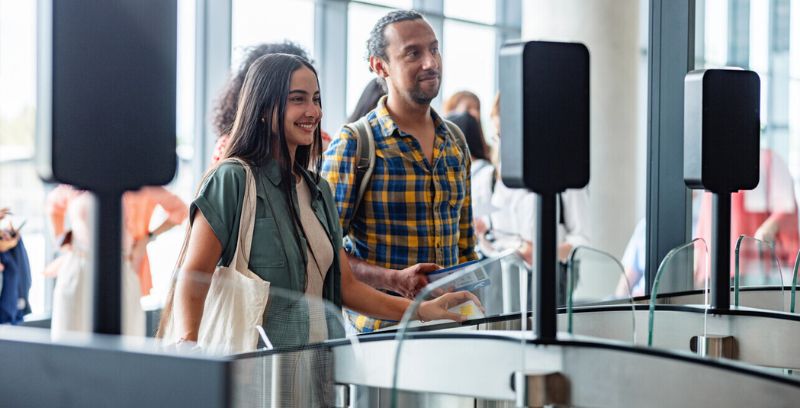
In addition, Amadeus eGates provide automated access for passengers and can be installed at pre-security, border control and boarding. With biometric technology, greater passenger control is offered. We’ve adopted design considerations that improve accessibility, including clear signage and instructions, cameras that can capture people at varying heights, and sufficient space for wheelchair users.
The future of travel: Why accessibility is key to long-term success
Better travel is about putting people first and creating experiences that are meaningful, personal, and centered around the traveler. It’s about empowering individuals with game-changing services and inspired choices and making effortless journeys that are full of joy. At its core, better travel is about simplicity, ease, and ensuring that all travelers are cared for every step of the way.
That’s why we believe that making travel more accessible is not only a moral imperative, but a strategic business decision that can unlock immense potential in a rapidly growing market. As the world’s population continues to age and more people with disabilities seek to explore the world, the demand for inclusive travel solutions will only rise. Companies like Amadeus are leading the way by developing innovative technologies and fostering a culture of inclusion, ensuring that every traveler, regardless of their needs, can enjoy a smooth and dignified experience.
But we can’t do it alone.
In such an interconnected industry, we must all work together to find innovative solutions to accessibility challenges, to transform travel, and to implement change at scale. By committing to accessibility today, we all stand to benefit from a more inclusive travel landscape. One thing is for certain, as the travel industry evolves, those who prioritize accessibility will be best positioned to thrive in an increasingly diverse and inclusive global marketplace.
TO TOP