







Gen AI and social media transform how U.S. travelers plan travel reveals new Amadeus research


Social media is now the primary source for travel inspiration, replacing family and friends, as those using AI to plan travel increases by 30% in the past year
Global study highlights widespread demand for technologies like biometrics that remove friction during the journey
U.S. travelers are increasingly turning to Generative AI and social media to plan travel according to a major new Amadeus global study, including 2,000 U.S. travelers.
Social media is now the primary source of travel inspiration having replaced ‘recommendations from family and friends’ to become the most influential channel - 34% of U.S. travelers now use social media to find ideas and inspiration for trips, flights and hotels. According to the research, the number of Americans turning to social media for travel inspiration increased 21% during the previous twelve months, with usage by Generation X (44-59 year-olds) growing more quickly than any other cohort (30%).
However, Generative AI is seeing the fastest growth (30%) with 17% of U.S. travelers now consulting AI tools like Chat GPT and Perplexity to source travel ideas. Travelers of all ages are turning to AI but use by baby boomers (60-78) increased most dramatically (60%) during the past year. This rapid growth means AI is already used by more travelers than traditional sources of inspiration, such as newspapers (12%) and travel agents with a physical presence (16%), which both saw modest year-over-year declines.
Traveler’s top sources of inspiration
Relative YoY change Social media 34% 28% +21% Family & friends 33% 33% 0% OTAs 25% 21% Social ads 24% 33% +9% Influencers 32% 18% TV 20% AI 17% 13% +30% Highstreet agent 16% 17% -5% Celebrities 13% 13% 0% 2025 2024 +19% +17% 21% +5% Newspapers 12% 13% -8%
"The way people plan travel is transforming rapidly as new digital sources of inspiration gradually replace established practices. New technology is improving every step in the journey from Gen AI inspiration to biometric check‑in and immigration at the airport. To truly deliver on traveler expectations of a seamless and intuitive experience we believe that more collaboration across the travel ecosystem is required. Every player involved in the traveler journey needs to work together to remove friction and prioritize the traveler, and technology can enable that.”
Decius Valmorbida President of Travel , Amadeus
“The excitement and anticipation about the potential of AI is clear, but the results of this study show that Gen AI tools aren’t yet ready for trip planning prime time. The travel and hospitality industry has a lot of work to do to harness AI. We need to work together to apply these new models specifically to travel, ensuring they are trained on reliable and accurate information with better integration to the existing travel ecosystem and new interfaces that better harness the potential for personalization.”
Francisco (Paco) Pérez-Lozao Rüter President, Hospitality, Amadeus
The study also revealed U.S. travelers are seeking reassurance using AI when traveling. 68% of travelers are willing to pay a one-off fee for an ‘AI-travel assistant offering in-trip information' stating they were open to an average charge of 5.8% of the cost of an entire trip. The figure was highest among younger travelers, with 76% of those aged 18-34 willing to pay for an AI assistant, along with 78% of 35–54-year-olds.
Transforming travel with a connected airport experience
When asked about difficulties encountered at the airport U.S. travelers said they are most concerned about losing travel documents (38%), lost luggage (35%) and long queues for security and check-in (33%). Perhaps that’s why respondents are increasingly open to using new technology at the terminal to increase convenience, reduce queues and remove friction.
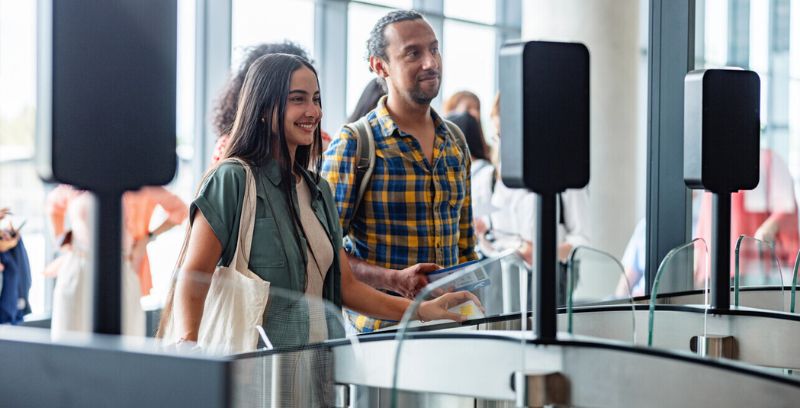
61% of Americans favored the use of biometrics to replace repetitive document and identity checks at key airport touchpoints like check-in, boarding and immigration.
Half of respondents said they would choose to have their bags checked-in and collected from their home and delivered to their destination.
A significant minority of respondents expressed a desire for digital wallets to securely store travel documents like passports and boarding passes.
Disruption management now a make-or-break issue for U.S. travelers
The study reveals it is how travel disruptions are handled rather than the fact they sometimes occur, which matters most in terms of traveler loyalty to a provider.
Three-quarters (75%) of respondents agree the true quality of a travel provider emerges clearly in how they handle and communicate about disruptions.
Streamlined, end-to-end technology solutions that enable effective disruption management can deliver a competitive edge: 73% indicate they would rebook with providers who handle disruptions efficiently and transparently.
The study revealed that the application of technology is widely supported by U.S. travelers, however 52% still prefer speaking to a human representative when problems arise alongside those who find reassurance in apps to manage disruptions independently, underscoring the need to provide a range of options.
TO TOP